
Topic starter
What can you expect from a psilocybin session?
What actually happens during a magic truffle session? How long does a trip last? What does psilocybin do to your brain and body? And why can the same dosage have a calming effect on one person, while having a deeply emotional or spiritual effect on another?
Perhaps you are considering a session and want to know what you are getting into. Maybe you have already read something about psilocybin and now want a more practical and biologically substantiated picture. In this article, I explain how a psilocybin session proceeds, from preparation to completion, and at the same time what happens biochemically. Not a vague story, but a down-to-earth explanation that fits well with the way we view it at Triptherapie.
In short: this is what you can expect
A psilocybin session usually lasts about five to six hours from the moment of ingestion, with the strongest phase roughly between one and a half and three hours after consuming the truffles. During those hours, your consciousness changes temporarily. Colors may appear more intense, thoughts proceed differently, time feels less linear, and emotions can come in more directly.
What many people underestimate is that preparation often makes more of a difference than just the dosage. Your mental state, the safety of the environment, your physical balance, your sleep, nutrition, stress level, and any medication all play a role. Good guidance is therefore not only pleasant but also an important part of the setting. This guidance is primarily for safety, peace, and trust, not to steer your experience.
No two sessions unfold exactly the same. One journey is calm, introspective, and gentle. Another session may be emotionally, visually, or spiritually charged. Both can be valuable.
What exactly is a psilocybin session?
A psilocybin session is a guided experience in which you consciously ingest magic truffles in a safe setting. The active ingredient in magic truffles is psilocybin, a natural psychedelic compound that temporarily alters the functioning of your consciousness, perception, and emotional life.
The word 'session' might sound clinical, but in practice, it involves something simple. You consciously take the time and space for an inner journey, while a facilitator is present to maintain oversight and ensure safety. This can be done individually, with a partner, or in a small group. Within Triptherapie, attention is usually paid not only to the experience itself but also to the preparation and the period afterward, so that the session is embedded in a larger whole of self-exploration, recovery, and integration.
From truffle to psilocin: what happens in your body?
When you ingest magic truffles, psilocybin is not yet the substance that causes the final effect. Your body converts psilocybin after absorption into psilocin. This usually starts to become noticeable within about twenty to forty-five minutes, although this can vary from person to person. Factors such as stomach contents, sensitivity, dosage, and stress play a role in this.
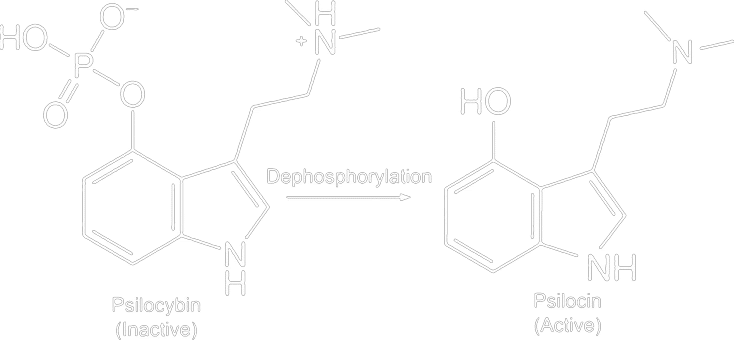
Psilocin is similar in chemical structure to serotonin, a neurotransmitter involved in mood, perception, sleep, impulse control, and the way information is processed in the brain. As a result, psilocin can bind to various serotonin receptors, particularly the 5-HT2A receptor. That receptor plays a central role in the typical psychedelic effects.
That effect is not limited to the brain alone. Serotonergic receptors are also found in other parts of the body. Therefore, it is biologically plausible that psilocybin influences not only perception and emotions, but also broader physiological processes such as stress regulation, inflammatory activity, and recovery mechanisms. This is also a reason why psilocybin is increasingly being discussed in relation to longevity and healthy aging.
What happens in your brain during a session?
One of the best-known effects of psilocybin is that fixed patterns in the brain temporarily become less tightly organized. Especially the so-called default mode network, The network active during worrying, self-reflection, memories, and the story you constantly construct about yourself becomes less dominant. As a result, familiar thought patterns can temporarily loosen.
For many people, that is precisely why a session feels different from normal thinking or talking. Thoughts enter less automatically in the same order. You are less stuck in familiar conclusions. As a result, memories, emotions, and insights can arise more freely. Some people experience this as liberating. Others primarily notice that they do not have to hold on to themselves as much. It can also cause someone to temporarily experience a lack of control, and that is simultaneously precisely why preparation and guidance are so important.
Psilocybin works not only psychologically, but also biochemically.
At Triptherapie, we look not only at what someone experiences, but also at the physical and biochemical state in which they enter a session. This is important because psilocybin does not enter an empty system. The effect is influenced in part by how regulated your nervous system is, how much stress you carry, how well you sleep, how stable your blood sugar is, whether there are deficiencies, and how strained your body is at that moment.
This aligns well with newer research linking psilocybin, and particularly psilocin, to processes such as reduced oxidative stress, decreased cellular aging, telomere preservation, and increased activity of repair-related proteins like SIRT1. This does not mean that psilocybin is already a proven anti-aging agent. Science is certainly not that far yet. However, it does show that the substance likely does more than just alter consciousness.
From the perspective of Triptherapie, this is logical. Mental health, stress physiology, sleep, hormones, lifestyle, and neurochemistry are intertwined. A deep session is therefore not only a mental experience but also a physical event.
Before the session: preparation makes a big difference
A good experience begins well before the ingestion of the truffles. The classic terms for this are set and setting, but in practice, this primarily means that both your mental and physical starting point are important.
Your mental state, the set, is about questions such as: where are you sitting, how much tension are you carrying, how open can you be to an experience, and how much control do you normally want to maintain? You certainly don't need to be perfectly balanced to do a session, but it does help to be aware of where you stand. Many people benefit from a few quieter days beforehand, less screen time, less social pressure, and some more sleep and nature.
The setting is at least as important. A quiet, safe, and familiar environment without unexpected stimuli makes a huge difference. Soft lighting, comfortable places to lie or sit, appropriate music, and a facilitator who remains calm help the nervous system feel safe enough to let go.
Within Triptherapie, preparation is often viewed even more broadly. Thinking extends beyond intention and environment to lifestyle, nutrition, and resilience. Sometimes, extra attention is given to reducing stress, improving sleep, stabilizing nutrition, or supporting neurochemical balance. In some programs, it is also assessed whether supplementation such as GABA or DHEA might be appropriate, depending on the profile, symptoms, and any test results. The underlying idea is not that supplements work magic, but that a better-regulated system often enables a deeper and more stable experience.
Practical preparation for the day itself
On the day of the session, it is usually advisable to eat lightly. A stomach that is too full can worsen nausea, while taking it completely on an empty stomach can be harder for some people. A light meal a few hours beforehand often works best.
Do not schedule any further obligations after the session. You do not want to have to rush, travel, or perform social duties. Comfortable clothing is important, and an extra sweater or blanket is often pleasant because temperature perception can fluctuate during a trip. Practical transportation afterwards is also part of good preparation. Driving yourself immediately after the session is not a good idea.
How does a psilocybin session usually proceed?
Although every experience is different, a session often follows a recognizable pattern. The timing may vary slightly, but roughly there are five phases: the initial physical shift, the ascent, the peak, the descent, and the landing.
Phase 1: the first thirty to forty-five minutes
After ingesting the truffles, your body begins to convert the psilocybin into psilocin. During this phase, you usually notice the first subtle changes. Your stomach may rumble a little, your hands may feel warmer or colder, and some tension or curiosity may arise. Some people still feel quite normal and simply continue talking. Others quickly notice that their attention turns more inward.
This is usually also the moment when guidance brings calm. Especially in the initial phase, someone may wonder whether it will work, whether it is becoming too intense, or precisely why so little is happening yet. A calm setting helps prevent falling into anticipatory anxiety.
Phase 2: the turnout
After about thirty minutes to an hour and a half, the effects become clearer. Colors may appear more intense, sound may penetrate deeper, and thoughts may take on a different rhythm. Many people experience a sense of wonder during this phase. Music sounds richer, details stand out more, and ordinary reality takes on an extraordinary quality.
At the same time, this can also be the most challenging phase for people struggling with the loss of control. You notice that your system starts functioning differently and that your usual mental anchor becomes less solid. That is normal. A good counselor will not intervene immediately, but will offer a calm presence that makes you feel safe.
Phase 3: the highlight of the experience
The strongest phase usually occurs between approximately one and a half and three hours after ingestion. This is the moment when you are in a fully altered state of consciousness. How this feels varies greatly from person to person. For one person, it is primarily visual; for another, it is emotional, physical, philosophical, or spiritual.
Some people see patterns, geometric shapes, or moving images with their eyes closed. Others primarily experience objects appearing softer or the space feeling more alive. Emotions can come in directly and intensely. A memory can suddenly be moving, an insight can feel incredibly clear, or you might experience a deep peace and acceptance without clear words or conclusions.
The sense of time also often changes dramatically. Minutes can seem like hours, and hours can feel like one timeless moment. That can be confusing, but also liberating, because you are no longer bound by normal clock time.
At Triptherapie, this phase is not viewed as something that needs to be controlled, but as a process that requires space. The facilitator monitors the setting and helps where necessary, but allows the experience to be yours as much as possible.
Phase 4: the descent
After the peak, the intensity slowly subsides. Your thoughts gradually become clearer, and ordinary reality comes somewhat more to the forefront again. Many people experience this phase as gentle, calm, and pleasant. As if the sharp edges of the experience disappear and there is more room to feel what actually happened.
In this phase, mild visual effects may still be present, especially with closed eyes or when fatigued, but the overwhelming nature has usually passed. You often notice increased hunger, thirst, and physical presence again as well. That is usually a good sign that the system is settling back down.
Phase 5: landing and the first hours afterwards
The strongest effects usually wear off about five to six hours after ingestion. You may not necessarily be completely clear-headed by then, but you will be largely back in a normal state. Some people want to talk immediately, while others need silence. Both are normal.
It often helps to eat something light, drink water or tea, and wrap up calmly. The night after a session, many people sleep deeply, although vivid dreams also occur. The next day, you may feel remarkably clear-headed, or conversely, somewhat sensitive and tired. That is also part of the process.
The afterglow effect and why that is interesting
After a psilocybin session, many people experience a kind of afterglow for days or sometimes weeks. This can manifest as increased calmness, clarity, emotional openness, connection, or motivation to make healthier choices. For some people, this feels like the most valuable part of the process.
From a biological perspective, this is interesting because such a period may be associated with increased neuroplasticity, altered stress regulation, and greater openness to behavioral change. That is precisely why integration is so important. Something may break open during the session, but it only takes shape in daily life in the days and weeks afterward.
What if things get difficult during the trip?
Not every session is entirely beautiful or pleasant. Difficult feelings may surface, such as fear, sadness, shame, loss, or tension. This does not automatically mean that something is going wrong. In many cases, it is actually a sign that something that normally remains suppressed is now being given more space.
The most important thing is usually not to fight against what is happening. However difficult that may be, resistance often makes the experience harder. Breathing calmly, being reminded of the setting, and knowing that it is temporary often helps the most. Sometimes a small adjustment helps, such as different music, a different posture, stepping outside for a moment, or simply the proximity of a guide.
Within Triptherapie, a difficult moment is not immediately viewed as a bad trip, but as a phase in which good guidance and surrender become extra important.
The role of guidance
Guidance during a psilocybin session is not there to take over your experience. It is primarily about safety, presence, and calm. A good guide is someone who has experience with the course of sessions, remains calm when you feel anxious, and knows when doing nothing is better than talking too much.
In an individual session, all attention is focused on one person. This often suits people who want maximum privacy or wish to do deeply personal work. In a small group, the dynamic is different. There, the presence of others can actually be reassuring. You are together, but each person makes their own inner journey.
See also: The most experienced trip guides
Individually or in a small group?
What suits you best depends on your personality and your intention. An individual session offers maximum attention, privacy, and space to go completely inward. This can be pleasant if you are working with very personal themes or if you become overstimulated easily.
A small group session can actually provide a greater sense of connection and support. Many people appreciate not being alone without having to do anything. You share the space, but not necessarily your process. Within Triptherapie, both forms are offered, depending on what best suits the individual and their needs.
See also: Group sessions with psychedelics
After the session: integration determines the true value
The session itself is important, but what you do afterward often determines how much value comes out of it. Integration means looking at what you have felt, seen, or understood, and whether that calls for anything in your daily life. Sometimes the insights are very concrete. Sometimes, mainly a feeling lingers. And sometimes you have more questions than answers. That, too, is normal.
In practice, integration can be very simple. Taking a rest, writing, walking, talking about it with a suitable person, sleeping better, eating healthier, or finally facing a difficult decision. Not every journey needs to be translated spectacularly. Sometimes the gain is being kinder to yourself, feeling your boundaries better, or not getting stuck in the same mental loop as much.
Who is a psilocybin session suitable for?
A psilocybin session requires openness, a certain willingness to temporarily let go of control, and sufficient mental stability. Not everyone is suitable for this at all times. People at increased risk of psychosis or severe psychiatric dysregulation usually fall short. outside the safe target group. Extra caution or exclusion is also necessary with certain medications, such as some antidepressants, MAO inhibitors, or lithium. Serious heart problems and pregnancy are also important considerations.
For people who are curious, seek depth, want to explore ingrained patterns, or wish to engage in a spiritual or emotional experience, a session can be particularly suitable. Within Triptherapie, therefore, the holistic profile is always considered, and not just the desire to have an experience.
Frequently asked practical questions
Below you will find Frequently asked questions from our forum about psilocybin sessions and truffle ceremonies.
How long does a full session last?
From ingestion to being largely sober, the effects of psilocybin usually last about five to six hours. Including preparation, wrap-up, and rest periods, count on six to seven hours for the entire session.
Can you drive after a session?
No, it is not wise to do so on the day itself. Plan transportation or an overnight stay if necessary. Driving is usually possible again the next day, but listen to your body.
How often can you do a session?
Most people do not often have sessions in quick succession. The body builds up tolerance quickly, and time is usually needed for the experience to sink in. For many people, a rhythm of occasionally rather than frequently suits them.
What are you bringing?
Usually not much. Comfortable clothing, perhaps something warm, and furthermore, above all, the willingness to devote time and attention to the experience. At a good location, the rest is usually provided.
Is a psilocybin session the same as a ceremony?
Not entirely. A ceremony often has a more ritualistic or spiritual character, even though we always have a psychologist present. A session can also be structured in a down-to-earth and practical way, focusing on safety, introspection, and guidance. Within Triptherapie, there are various forms, ranging from more therapeutically oriented sessions to more spiritual settings. You can let us know your preference, and we will work with you to find the best solution.
Finally: what makes a session really good?
A good psilocybin session is not necessarily the one with the most visuals, the greatest emotional release, or the most spectacular story afterward. A good session is one in which you feel safe, where the setting is right, where your body and mind are sufficiently prepared, and where you are given the space to follow your own process.
Psilocybin often opens a temporary door. What you experience behind it varies from person to person. Sometimes it is insight, sometimes release, sometimes wonder, sometimes silence. Good guidance ensures that that door can open safely and that you return calmly.
It is precisely when you connect the psychological experience with the biochemical side—the preparation and the integration—that it becomes clear why Triptherapie looks not only at the trip itself, but at the entire process surrounding it. This increases the likelihood that a session is not only special at that moment, but also gains meaning in the long term.
Sign up? Here you can the complete online intake or read more about the here psilocybin session
Posted : 15 March 2026 20:33