11 January 2025 11:27
Topic starter
1

Is there any scientific evidence that psilocybin helps with Multiple Sclerosis (MS)?
2 Answers
2
7 June 2025 11:02

There is currently no direct scientific evidence that psilocybin helps with Multiple Sclerosis (MS). A small 2019 study investigated the effects of psilocybin on depressive symptoms and quality of life in people with advanced MS. The results showed that psilocybin reduced symptoms of depression and anxiety and that the improvement in quality of life persisted for up to 5 weeks after treatment in some participants. However, the effect of psilocybin specifically on MS itself has not been investigated further. There is, however, theory suggesting that psilocybin may potentially reduce MS damage by increasing neuroplasticity and neurogenesis, but for the time being this remains a theory without scientific evidence that it is effective in people with MS.
1
10 March 2026 19:28
There are no large-scale, randomized clinical trials with psilocybin in MS patients has been published. However, a small pilot study was conducted in 2019 in people with advanced MS, in which psilocybin was administered. with psychological counseling. This study focused on depressive and anxiety symptoms as well as quality of life. The findings were that a single dose of psilocybin reduced depression and anxiety symptoms, and in some participants, the improved quality of life persisted for up to approximately 5 weeks after the session. Such an effect is consistent with previous studies on psilocybin for depression and anxiety (non-MS related). Important: This study did not assess direct effects on MS disease activity, motor functions, pain, spasms, or fatigue; to date, there are no data on psilocybin's influence on the course of MS itself.
Patient reports and therapists' websites show that psilocybin primarily improves mood. For instance, Triptherapie.nl notes that their clients with MS often report an improved mood after a session. A better mood and less stress can indirectly improve an MS patient's daily functioning, but this remains anecdotal. The therapists themselves emphasize that all experiences are primarily simple and non-systematic are, and provisionally call psilocybin effects on MS symptoms “sour theoretical”. A Q&A on the same forum also states outright that “there is currently no direct scientific evidence” that psilocybin influences MS disease activity.
In short: Clinical literature on psilocybin in MS is lacking., with the exception of a few smaller case reports/pressurization reports and the mentioned depression study. Most data indicate that a psilocybin session the mood improves and can alleviate symptoms of anxiety or depression in MS, but there is no evidence that psilocybin reduces, for example, pain, spasticity, or physical disability in MS.
Preclinical research (animals and cell models)
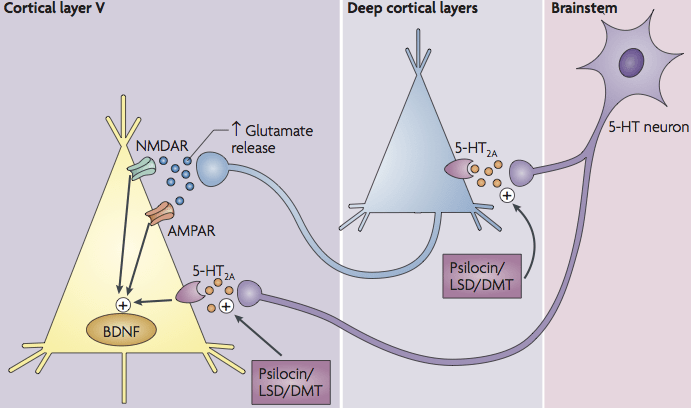
Preclinical research into psychedelics suggests several mechanisms of action that are theoretically relevant to MS. Psilocybin (via psilocin) is an agonist of the serotonin 5-HT₂A receptor, and active 5-HT₂A stimulation has strong neuroplastic and anti-inflammatory effects. For example, psilocybin promotes the in animal models and cell cultures expression of BDNF (Brain-Derived Neurotrophic Factor) and other plasticity markers in the cortex and hippocampus. In one mouse study, a single dose of psilocybin normalized reduced BDNF and mTOR levels 7 days after administration, suggesting recovery of stress-related neuroplasticity. In mice, psilocybin increases the activity of TrkB (the BDNF receptor) and dubelcortin (new neurons) in prefrontal brain regions. This raises hopes that in MS damage (where axons and myelin are lost), additional neurotrophic factors may contribute to recovery or compensation. Indeed, there are animal studies (not with psilocybin) showing that elevated BDNF reduces disease activity in an MS model.In mice with an MS-like disease presentation, BDNF administration led to reduced inflammation and demyelination. This supports the hypothesis that psilocybin, which increases endogenous BDNF, may have neuroprotective/neurorepair effects.
At the same time, research points to immunomodulatory effects. In vitro (cell culture) studies show that psilocybin and its metabolite psilocin inhibit pro-inflammatory signaling. In a microglia model (brain macrophages activated by LPS), psilocybin/psilocin strongly inhibited TNF-α production and increased BDNF. These effects occurred via 5-HT₂A/2B/7 receptors and TrkB; demonstration via alternative pathways (AhR receptor for BDNF uptake) points to multifaceted anti-inflammatory activity. Psychedelic mushroom extracts were also found to lower inflammatory markers in human cells under LPS stimulation. This suggests that psilocybin, via psilocin and 5-HT₂A activation, can “recalibrate” the immune system (e.g. reduced TNF-α) without high (hallucinogenic) dosage.
Finally, no specific animal studies with psilocybin in MS models (such as EAE or cuprizone) have been reported. However, the preclinical findings taken together show that psilocybin possible has inhibitory effects on neuroinflammation and actually stimulates neurogenic repair processes. Below is a summary table of some relevant findings from the laboratory research:
| Research (year) | Model/type | Results (key findings) |
|---|---|---|
| Small pilot (2019) | People with advanced MS | Psilocybin lowered depression and anxiety scores; improved quality of life (up to 5 wk) |
| Laabi ea (2025) | In vitro: LPS-activated microglia | Psilocybin/psilocin ↓TNF-α and ↑BDNF (via 5-HT2A/2B/7 and TrkB) |
| Davoudian et al (2023) | Mouse (chronic stress model) | Psilocybin restores BDNF and mTOR signal in prefrontal cortex; ↑neuroplasticity markers |
| Kovalchuk et al. (2023) | Human 3D intestinal model (LPS/IFNγ) | Psilocybin (with eugenol) reduced inflammatory markers and cytokines in epithelial cells. |
Anecdotal evidence (experiences of patients/therapists)
On non-scientific platforms (blogs, forums) we find numerous personal stories from MS patients and caregivers. Many patients report after a psilocybin experience reduced fatigue, less nerve pain and clearer thinking. For instance, users on forums write that their chronic fatigue virtually disappeared during the trip, tingling decreased, and cognitive “fog” was relieved. Others report that high doses of psilocybin drastically reduced or even temporarily eliminated their MS-related nerve pain (e.g., chronic neuropathy). However, these stories stand not yet in the scientific literature and are based on individual anecdotes.
Dutch sources refer primarily to improved mood and stress reduction. The therapists at Triptherapie.nl write in their blog that MS clients almost always report an improvement in mood and stress after a session. However, they themselves emphasize that these improvements after all are derived from individual sessions and not from controlled research. An open discussion on the Triptherapie forum concludes in summary: “there is currently no direct scientific evidence that psilocybin helps with Multiple Sclerosis”. According to experts by experience, the most common anecdotal benefits of psilocybin for MS are reduced pain, better sleep, and increased motivation; for some, this can make MS symptoms feel less burdensome.
Please note: this Anecdotal evidence has not been verified. Patient stories can point to interesting perspectives, but they cannot be generalized. Until rigorous clinical research is conducted, the scientific evidence remains limited to what is described above (mood improvement in a small study, mechanistic indications in preclinical work).
Conclusions
There is (yet) no convincing scientific evidence that psilocybin inhibits the underlying neuroinflammatory processes of MS. A small study does suggest beneficial effects on depressive symptoms and general quality of life in MS patients. Preclinical research shows that psilocybin activates anti-inflammatory and neuroplastic pathways (more BDNF, fewer pro-inflammatory cytokines), which could theoretically be useful in an inflammatory disease like MS. Patient reports are hopeful but purely anecdotal.
Clinical applications: If psilocybin were ever investigated as a therapeutic agent for MS, this would likely be limited for the time being to relieving depression and anxiety in MS patients (where much positive research already exists). Its effectiveness on motor symptoms, pain, or spasticity is completely unproven.
Recommendation: MS patients considering psilocybin should be aware of the lack of solid evidence and the legal/mental health risks. Participation in a scientific study (if available) or under the guidance of a psychedelic therapist is safer than independent experiments. For the time being, psilocybin use in MS is based on personal choice and expertise based on experience, not yet on (published) clinical guidelines.