
Topic starter
Imagine that you are about to embark on a psychedelic journey with magic truffles. Everything is prepared, the setting is right, and yet you feel tension. That is perfectly normal. Precisely at that moment, it often revolves around one core skill: daring to let go. Acceptance is not only the key to a valuable trip, but also to the way you approach difficult emotions, uncertainty, and loss of control in life. Within Triptherapie, this same principle is also more broadly linked to self-healing, emotional processing, and creating circumstances in which psychedelics can have a therapeutic or insightful effect.
During a psilocybin session, it often becomes clear how strongly we normally try to maintain a grip on what we feel, think, and experience. But under the influence of psilocybin, control often backfires. The more you resist what presents itself, the stiffer and more uncomfortable the experience can become. Those who learn to let go, on the other hand, often find that the journey becomes softer, deeper, and more insightful. This also aligns with how Triptherapie describes psychedelics: not as ordinary drugs, but as a distinct category of substances that are particularly interesting because of their influence on consciousness, emotional processing, and neuroplasticity.

Why resistance can make a trip harder
Psilocybin usually amplifies not only beautiful feelings, but also that which is already present beneath the surface. These can be wonder, love, and connection, but also fear, sadness, shame, or inner tension. The moment such feelings arise, the tendency is often to suppress them. It is precisely there that friction often arises. Triptherapie describes that old, long-blocked emotions regularly surface during psilocybin sessions, and that allowing them can be liberating.
In many cases, a difficult trip is not so much the result of the content of the experience, but of the struggle with it. It then feels as if you are trying to swim against a strong current. That takes a lot of energy and gives the feeling of being overwhelmed. When, instead, you dare to move with the flow a little more, the experience often changes. Not because everything suddenly becomes pleasant, but because there is less need for conflict. Within Triptherapie, we see that difficult moments often become more bearable and valuable when someone does not try to escape what is happening, but learns to remain present with the experience. That does not mean that everything has to be fun. It means that space is created for what wants to reveal itself.
What ACT says about this
Modern psychology has a clear language for this. Within Acceptance and Commitment Therapy, usually abbreviated as ACT, the focus is not on how to get rid of difficult thoughts and emotions, but on how to deal with them differently. ACT is based on the idea that psychological flexibility is more important than control.
Within ACT, acceptance means making space for what you experience inside, even if it is uncomfortable. You don't have to resolve fear immediately. You don't have to get rid of sadness right away. You don't have to fix confusion before you can move on. You let the experience be there for a moment, without immediately fighting against it.
Another important principle of ACT is defusion. This means learning to see that thoughts are not the same as facts. During a psychedelic experience, a thought can feel incredibly real, for example: “this is going wrong” or “I can’t get out of this.” Defusion helps to distance yourself from it just a little more. Instead of completely identifying with that thought, you can notice: “I notice that I have the thought that this is too much.” Even that small difference can create a lot of space.
Psilocybin actually seems to temporarily increase that psychological flexibility. Fixed thought patterns become less rigid. This creates the possibility to experience emotions and beliefs in a new way. That makes ACT particularly relevant as a lens for understanding psychedelic experiences.
The Stoic lesson of control and surrender
Stoic philosophy also aligns surprisingly well with this. Stoics such as Epictetus and Marcus Aurelius emphasized as early as two thousand years ago that peace begins with the distinction between what you can and cannot control.
You have influence over your attitude, your attention, your choices, and how you react. You have no direct control over what presents itself during a psychedelic session. You do not choose exactly which emotions, memories, or images come up. Nor do you choose exactly how intense a particular phase feels. As soon as you try to control what is beyond your power, the inner struggle intensifies.
The Stoic approach would therefore be: accept the reality of the moment and focus on what is still within your influence. Your breathing. Your willingness to observe. Your choice not to run away from what arises. It is precisely that which provides inner strength.
Marcus Aurelius wrote that you have power over your mind, not over external events. During a trip, that thought can become very concrete. You cannot stop the wave, but you can learn how to move with it.
What happens biochemically when you let go
Acceptance is not just a psychological concept. It also has a physical side. Psilocybin is converted into psilocin in the body and acts primarily via serotonergic receptors, particularly the 5-HT2A receptor. The Triptherapie blog places a strong emphasis on that serotonergic profile and names 5HT2a as a core receptor for the altered perception and mood. The recent npj Aging-study partially aligns with this and describes that 5-HT2A receptors are found in multiple organs and cell types, including fibroblasts, neurons, cardiomyocytes, endothelium, epithelium, macrophages, and T cells.
This receptor activation changes the way information is processed in the brain. The default mode network, the brain network heavily involved in self-reflection, control, worrying, and clinging to one's narrative about oneself, often becomes less dominant. Triptherapie describes this as a decrease in DMN activity, which can cause the sense of time to fade and concerns about the future and self-image to become less dominant. This is one of the reasons why a loss of control can be so palpable during a session. The usual mental structure you normally rely on becomes temporarily looser. If you fight against this, it often feels unsafe. If you learn to move with it, it can actually be liberating.
BDNF, neuroplasticity and new connections
An important element of the Triptherapie blog is the emphasis on BDNF, brain-derived neurotrophic factor. It is explained there that many psychedelics are associated with greater neuroplasticity and possibly increased BDNF activity via serotonergic activation, making it easier for new connections in the brain to form. The blog links this to faster learning, better adaptation of neural networks, and possibly also to protection against stress and depressive patterns. That is the Triptherapie view. Scientifically, the general idea that psilocybin can promote neuroplasticity is open to debate, but not every concrete conclusion drawn from that blog has been hard-proven to the same extent.
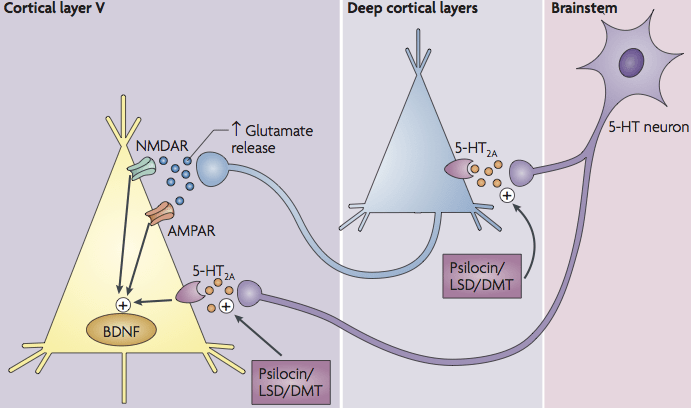
It is precisely from this perspective that acceptance becomes so relevant. If psilocybin temporarily makes old patterns less rigid, this not only increases the chance of new insights but also the chance that you deal with difficult feelings in a different way. In that case, letting go is not only philosophically or therapeutically interesting but also neurobiologically logical.
Less ego, more connection
The Triptherapie blog adds another important theme: less ego. It is described there that higher doses of psychedelics can temporarily push self-awareness into the background, causing connectedness to be experienced more strongly and the usual focus on self-preservation, restlessness, and separateness to diminish. In this view, less ego can go hand in hand with less stress, less DMN activity, more serotonergic space, and more felt connectedness.
That ties in nicely with acceptance. For resistance often stems from the part of us that wants to protect itself and control the experience at all costs. When that self-awareness temporarily softens, the experience can become more open. For many people, that feels as if they no longer have to hold on as much to who they thought they were. That can be daunting, but also deeply liberating.
Emotions are allowed to be there.
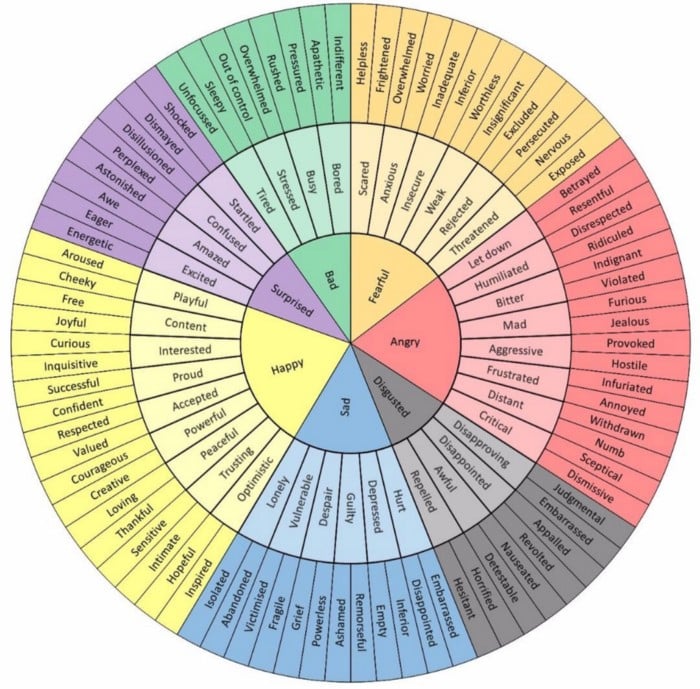
One of the strongest elements of the Triptherapie blog is perhaps the simple sentence that all emotions are allowed to be there. This blog describes how psychedelics sometimes actually bring people into contact with old pain, blocked feelings, and psychosomatic tension, and that liberation often lies not in avoiding them, but in finally fully feeling what has long been stuck.
That ties in directly with acceptance. A valuable trip is by no means always a comfortable trip. Sometimes the real shift only occurs when grief, loss, tension, or shame no longer need to be suppressed. Precisely because psilocybin can also amplify feelings of contentment, connection, or gentleness, difficult emotions can sometimes, paradoxically enough, be felt more safely than in the ordinary state. That makes the experience confronting, but often also healing.
Hallucinations, symbolism and insights
Additionally, hallucinations or whether visions are important for letting go. There is a distinction between substances such as MDMA, which produce few hallucinations in usual doses, and substances such as psilocybin, LSD, and DMT, which are known specifically for visual and symbolic experiences. Hallucinations combined with the other effects can lead to new insights, spiritual experiences, or an experience difficult to put into words.
In the case of acceptance, this is important, because visual or symbolic experiences sometimes only acquire meaning when you do not immediately try to understand or control them. Some insights do not arise through control and analysis, but rather through allowing, experiencing, and only later integrating.
What recent longevity research adds
The npj AgingA 2025 study provides an additional biochemical layer. The researchers write that psilocin extended cellular lifespan in human lung fibroblasts by 29 percent at 10 μM and by 57 percent at 100 μM. A lifespan extension of 51 percent was also observed in adult human skin fibroblasts, along with reduced oxidative stress and preservation of telomere length. In the mouse study, the psilocybin group had a higher survival rate after ten months than the control group, 80 percent versus 50 percent. The authors call this the first experimental indication that psilocybin can influence multiple hallmarks of aging, including senescence, oxidative stress, DNA stability, and telomere preservation.Nature)
That does not mean that psilocybin is now proven to be an anti-aging agent for humans. We cannot verify that based on a single preclinical study. However, it does support the broader idea that psilocybin acts not only on the psyche, but possibly also on systemic repair and aging pathways. By extension, it becomes understandable why we place topics such as stress reduction, connectedness, BDNF, reduced ego, and increased emotional flow side by side in Triptherapie.
Rejuvenation of DNA, the body, and the psyche may potentially lead to greater acceptance. At least, we observe a higher level of acceptance among younger people than among adults. However, this effect requires further research.
How do you concretely apply acceptance during a trip?
Acceptance sounds simple, but during an intense experience, it is not always easy. Nevertheless, there are a few practical ways you can help yourself.
Breathing is often the first anchor. Not to breathe away the experience, but to remain present. By calmly observing how the breath comes and goes, a little more space is created between you and what you feel.
It also helps to gently name what is happening. Not to analyze, but simply to notice: “here is fear,” “here is sadness,” “here is confusion.” By naming this without judgment, you become more the observer of the experience than its victim.
Sometimes it helps to ask yourself what happens if you stop fighting for a moment. Not because that is immediately easy, but because precisely that question can weaken the grip of resistance. A small shift from “this must go” to “this is allowed to be here for a moment” can change a lot.
Trust also plays a major role. Not blind trust that everything will always be pleasant, but trust that the experience is temporary and that difficult phases are not necessarily wrong. Often, the value lies precisely in the part you would normally run away from.
The body and voice can also help. Sighing, crying, making sounds, changing posture, or sitting up straight for a moment can release tension. Acceptance is not passively enduring. It is actively making space for what is.
The role of the facilitator in acceptance
Precisely when acceptance becomes difficult, good guidance is important. An experienced guide does not need to take over or steer a trip, but can make the difference between panic and surrender. Sometimes through a calm presence. Sometimes through a simple reminder such as: breathe, let it come, you are safe. Sometimes through physical grounding, if appropriate.
Within Triptherapie, guidance is therefore not only practical but also regulatory. The website describes that programs start with an intake form, followed by initial advice regarding session type and dosage. The programs are conducted under the supervision of a BIG-registered advisor are performed and supervised by academically trained psychologists and therapists with relevant registrations, supplemented by internally trained guides.

What you learn during a trip, you take with you into life.
The value of acceptance does not end when the psilocybin wears off. Many people notice after a good session that they react slightly less tensely in daily life. That situations feel less threatening. That emotions are allowed to be there more without needing to be resolved immediately.
That is precisely why psychedelic experiences sometimes have such a profound effect. You understand acceptance not only with your head, but feel what it is like to truly let go of control. That experience often continues to have an effect for a long time. You notice, for example, that you are less stuck in worrying, less quick to become defensive, or that you can remain more present with uncomfortable feelings.
Here, too, ACT and the Stoics align beautifully. Not everything in life can be engineered. Not everything needs to be fixed immediately. Sometimes, the greatest peace arises precisely when you stop fighting against the reality of the moment.
When acceptance remains difficult
It is important to be honest, however: acceptance is not a trick that always works immediately. Certainly not when deep fear, old pain, or traumatic baggage surfaces. In such cases, letting go can be very difficult. That does not mean you are failing. It simply means that you are hitting a boundary where support, preparation, and safety become even more important.
That is why preparation is so valuable. Those who practice mindfulness, breathing, observing without judgment, or body awareness beforehand often have more stability during a trip. Not because it always makes things easy, but because an inner language is already available to deal with intensity.
Acceptance, by the way, does not mean that everything is fine or that you no longer have any boundaries. It simply means that you first acknowledge what is happening now, before deciding what to do with it. That is different from passivity. It is a mature form of openness.
The paradox of letting go
There is a peculiar paradox in psychedelic work. Precisely when you stop trying to control everything, you often experience more inner stability. When you allow yourself to feel what is, it becomes less overwhelming. When you no longer want to change the experience at all costs, space for insight opens up.
That paradox applies not only during a trip, but also outside of it. Much suffering arises from the constant attempt to fully control life. Psilocybin can show very directly how exhausting that is and how liberating it can be to move a little more with what presents itself.
How psilocybin can help with this actually goes even further than described above. More on that later.
Finally
Acceptance and letting go often hold the key to a valuable psychedelic experience. Not because everything becomes easy, but because the struggle with the experience diminishes. What initially seemed threatening can then transform into something educational, moving, or even healing. The Triptherapie blog adds a clear perspective of its own to this: psychedelics supposedly work not only through experience, but also through increased BDNF, reduced DMN dominance, less ego fixation, greater emotional flow, and new perspectives via hallucinations. Part of this aligns well with the broader scientific picture, while another part is clearly an interpretation from Triptherapie itself and not fully clinically proven.
From modern psychology, Stoic philosophy and knowledge by guided truffle sessions The same insight keeps coming back: you don't have to control everything to be safe. Sometimes, the greatest peace arises precisely when you soften the need for control. That is perhaps one of the deepest lessons of psilocybin. Not only how to better endure a trip, but also how to learn to live more freely.
Posted : 15 March 2026 20:55