
Topic starter
For a long time, we viewed magic mushrooms and truffles as tools for a spiritual journey. But science has discovered a new layer: psilocin (the substance into which psilocybin is converted) is a powerful modulator of our immune system and our cellular health.
From protecting the pancreas to calming an overactive brain, the biochemical pathways psilocybin follows are as complex as they are promising. Through these various pathways, psilocybin can help with diverse conditions, which we discuss in this post.
The Foundation: The 5-HT2A Receptor
To understand why a mushroom experience affects your gut, your joints, or your pancreas, we need to look at the 5-HT2A receptor. Although this receptor is famous for its role in the brain (where it is responsible for visual and spiritual effects), it is found throughout our entire body: on immune cells, in blood vessels, and in our organs.
When psilocin (the active form of psilocybin) binds to this receptor, something unique happens that we biased agonism to name. The receptor is not simply switched 'on'; it is pressed into a specific state that triggers a cascade of healing, anti-inflammatory reactions.
1. The Brake on the 'Ignition Engine' (NF-κB)
The main action of the 5-HT2A receptor is to block the NF-κB route. NF-κB is a protein complex that acts as the 'master switch' for inflammation in our cells.
-
The normal position: Under stress or illness, NF-κB activates genes that produce cytokines such as TNF-alpha and IL-6 produce.
-
The psilocybin mode: Binding to the 5-HT2A receptor inhibits the production of NF-κB. As a result, the inflammation 'thermostat' in your entire body drops. This explains the direct decrease in CRP (C-reactive protein) after use.
2. Intracellular Rest: STAT-1, STAT-3 and TXNIP
Inside the cell, 5-HT2A activation causes a reduction of phosphorylation. This is a process in which proteins are 'activated'. Psilocybin prevents stress proteins such as STATE-1 and STATE-3 can do their work. In addition, the interaction with TXNIP reduced. This is essential, because an excess of active TXNIP leads to cell death and insulin resistance. By blocking this pathway, psilocybin literally acts as a protective shield for your cells.
3. From Chaos to Order: Gene Expression
The 5-HT2A receptor also acts as a gatekeeper for our DNA. Activation causes a shift in which genes are 'on' or 'off':
-
Scaling up recovery: Genes such as TREM2 (for healthy brain cleansing) and DUSP1 (a natural anti-inflammatory) are further stimulated.
-
Scaling down aggression: The expression of TLR4 (the 'detector' for harmful bacteria that often triggers false alarms) and EGR2 is lowered, causing the immune system to stop attacking the body itself.
4. The Role of BDNF and Neuroplasticity
Finally, the 5-HT2A receptor stimulates the release of BDNF. As inflammatory markers decrease, this 'growth factor' increases. This creates the ideal conditions for neuroplasticity: the brain can not only stop being inflamed, but can also actually start repairing the damage caused by chronic stress or disease.
In short: The 5-HT2A receptor is the conductor of an orchestra. Where chronic disease causes false, loud notes (inflammation), psilocybin forces the conductor to return to a harmonious, calm rhythm.
1. Neurodegenerative Disorders: The Salvation of the 'Gray Cells''
In diseases such as Alzheimer's and Parkinson's, there is a tragic misunderstanding in the brain. The microglia—the immune cells that act as the janitors of our brain—turn from quiet cleaners into aggressive soldiers. Instead of merely clearing away waste products (such as amyloid plaques), they begin to attack healthy neurons and synapses. Psilocybin intervenes in this process via three crucial mechanisms:
A. TREM2: The Reprogramming of the Microglia
It TREM2 gene is currently a 'hot topic' in dementia research. This gene tells the microglia when to stop fighting and start recovering.
-
The problem: In neurodegeneration, this gene 'silences', causing microglia to remain stuck in a chronic inflammatory state.
-
The solution: Psilocybin causes a increased expression of TREM2. This reprograms the immune cells to a protective role. In this state, they can clear toxic proteins without causing "friendly fire" on healthy brain cells.
B. Control of Phagocytosis: No More 'Friendly Fire'
Phagocytosis is the process by which immune cells 'eat' other cells. In a healthy brain, this is useful for clearing away dead cells. However, in Parkinson's and Alzheimer's, the microglia become overstimulated and begin to digest healthy, vital synapses.
-
The intervention: Research shows that high doses of psilocybin regulate this process. By inhibiting the STAT-1 and STAT-3 routes (which send the seizure signals), the microglia are instructed to leave the healthy neurons alone. This inhibits the progression of the disease and preserves the existing brain structure.
C. The BDNF Boost: Architecture of Recovery
Once the inflammation has calmed down (due to the reduction of NF-κB and IL-6), the brain must also be given the chance to recover. This is where BDNF (Brain-Derived Neurotrophic Factor) in the picture.
-
Brain fertilizer: Psilocybin significantly increases the concentration of BDNF. This protein stimulates neuroplasticity: it ensures that neurons can form new connections and that damaged cells survive longer.
-
Synergy: While the anti-inflammatory properties of psilocybin put out the "fire," BDNF acts as the contractor that repairs the damage. This is essential for maintaining memory and motor skills.
Why this gives hope
Unlike many current medications that only combat the symptoms, psilocybin focuses on the cause: the derailed immune response in the brain. Due to the gene expression of DUSP1 and SGK1 to influence, it helps brain cells become more resilient against the daily stress associated with aging and illness.
2. Psychiatric & Psychosomatic Complaints: Calming the 'Inflamed' Mind
In modern psychiatry, one theory is rapidly gaining ground: the inflammatory hypothesis of depression. We view depression, burnout, and chronic anxiety less and less as merely a "serotonin deficiency" and more and more as a state of chronic, low-grade inflammation in the brain. Psilocybin acts as a powerful biological coolant in this process.
A. Inflammation Markers: The End of Sickness Behavior'
Have you ever wondered why you have no energy, feel sluggish, and avoid social contact when you have the flu? We call that sickness behavior, and it is caused by cytokines such as IL-6 and CRP. In people with chronic depression or burnout, these markers are continuously "on," as if the body thinks it is constantly fighting a virus.
-
The Reset: Research shows that after psilocybin use, the levels of Interleukin-6 (IL-6) and C-reactive protein (CRP) decrease significantly.
-
The Result: By lowering these markers, the physiological "flu feeling" in the mind disappears. The fog lifts, motivation returns, and the heaviness so characteristic of depression diminishes.
B. Gene Expression: The Biological Brake on Stress (DUSP1 & SGK1)
Psilocybin does more than just adjust fluids in your blood; it reprograms how your cells respond to stress via specific genes:
-
DUSP1 (Dual Specificity Phosphatase 1): This gene acts as an 'off switch' for stress signals in the cell. Psilocybin increases the expression of DUSP1, thereby tempering hyperactivity in the brain regions that process fear and stress (such as the amygdala).
-
SGK1 (Serum/Glucocorticoid-regulated Kinase 1): This gene plays a key role in how we deal with cortisol (the stress hormone). By increasing the expression of SGK1, psilocybin helps the brain become more resilient to future stressful events. It literally helps repair the "biological damage" from prolonged stress.
C. Break the 'Rigid' Spirit
When the brain is "inflamed," it becomes rigid. You get trapped in negative thought loops (rumination). Due to the combination of lower inflammation and higher BDNF concentration, a "window of opportunity" arises.
The increased expression of genes such as IκB-α ensures that the pro-inflammatory factor NF-κB remains inactive. This gives the brain the rest needed to lay down new, more positive neural pathways. You stop surviving and start living again.
In short: Psilocybin treats the psychiatric complaint not only as a psychological problem, but as a physical blockage. It clears away the biochemical "noise," creating space again for therapy, self-reflection, and recovery.
3. Autoimmune Diseases & Chronic Inflammation: The Molecular Peacemaker
Whereas conventional medication often suppresses one specific symptom, psilocybin intervenes at the source code of the inflammation. It does not work like a blunt axe, but as an intelligent regulator that restores the communication lines of the immune system.
A. NF-κB: The Main Switch of the War Machine
In every cell there is a protein complex called NF-κB. Think of this as the 'general' giving the command to launch the attack. In chronic inflammatory diseases, this general is constantly shouting, leaving your body in a permanent state of readiness (and damage).
-
The Intervention: Psilocybin inhibits the production and activation of NF-κB (specifically the p65 subunit).
-
The Result: Because the general remains silent, the genes that fuel inflammation are no longer 'read'. The entire cascade of aggressive reactions stops before it can cause damage to your gut, joints, or skin.
B. TNF-alpha & COX2: Natural Pain Relief and Anti-Inflammation
When the NF-κB pathway is active, the body produces large quantities. TNF-alpha (a signaling substance that spreads the inflammation) and COX2 (an enzyme that causes pain and swelling).
-
The Target: The most modern medicines for rheumatism (biologicals) specifically target the blocking of TNF-alpha. Psilocybin does this naturally.
-
Comparison with painkillers: Lowering the amount COX2 is exactly what NSAIDs like ibuprofen or diclofenac do. Psilocybin lowers the amount of this enzyme directly at the source, potentially reducing the need for chemical painkillers.
C. TLR4 & CD80: The Sensitivity of the 'Security Cameras''
Your immune cells use receptors such as TLR4 and CD80 to scan the environment for danger. In autoimmune diseases, these 'cameras' are set far too sensitively; they see an enemy everywhere.
-
The Calming: Psilocybin reduces the expression of these genes. As a result, the immune system becomes less 'hyper-reactive'.
-
Result: The army is no longer mobilized for every trifle. This brings rest to the intestinal wall in Crohn's patients and prevents joint capsules from being attacked in rheumatism.
D. The STAT-1 & STAT-3 Route: Cell Communication Under Control
In addition to the major known pathways, psilocybin also inhibits the phosphorylation (activation) of STATE-1 and STATE-3. These proteins are essential for transmitting inflammatory signals from outside the cell to the nucleus.
By blocking these pathways, psilocybin effectively pulls the plug on the immune system's loudspeakers. The cells no longer communicate about 'attacks', but return to a state of homeostasis (balance).
What does this mean in practice?
The reduction of systemic markers such as CRP (C-reactive protein) After use, it is tangible proof that biochemical calm has returned. For someone with a chronic inflammatory disease, this can mean the difference between a daily battle against pain and a body that finally gets the chance to recover.
4. Metabolic Disorders: Protection of the Pancreas and Sugar Metabolism
Type 2 diabetes and metabolic syndrome are often viewed as merely "sugar diseases," but the core of the problem is chronic cellular stress and inflammation. Psilocybin appears to intervene at a very specific molecular level that is crucial for the survival of our insulin-producing cells.
A. TXNIP: The Link between Sugar and Cell Stress
TXNIP (Thioredoxin-interacting protein) is a protein that acts as a sensor for cellular stress. When your blood sugar is chronically too high, TXNIP becomes overactive. This leads to the activation of the NLRP3 inflammasome, a kind of internal alarm bell that causes massive inflammation and ultimately cell death.
-
The Intervention: Psilocybin inhibits the phosphorylation (activation) of TXNIP.
-
The Result: By keeping TXNIP in check, the vicious cycle of high sugar is broken. more stress more inflammation is broken. This reduces so-called "glucotoxicity", meaning cells are less likely to be damaged by sugar fluctuations.
B. Protection of the -cells (Beta cells)
The beta cells in your pancreas are the only cells in your body that can produce insulin. In Type 2 Diabetes, these cells become "exhausted" and die due to constant exposure to pro-inflammatory cytokines such as TNF-alpha and IL-6.
-
The Shield: Because psilocybin the gene expression of NF-κB and lowers the production of these cytokines, it creates a safer environment for the pancreas.
-
Survival: The inhibition of the STAT-1 and STAT-3 Pathways play a key role in this. These pathways normally send the signal to the beta cell to commit "suicide" (apoptosis) in the event of excessive stress. Psilocybin blocks this signal, thereby preserving the beta cells and allowing them to continue performing their function.
C. Improved Insulin Sensitivity
Outside the pancreas, psilocybin has a systemic effect that is beneficial for your metabolism:
-
Lowering of CRP: Lower C-reactive protein in the blood is directly correlated with better insulin sensitivity in your muscles and liver.
-
Hormonal Balance: The increased expression of the SGK1-gen helps regulate transport mechanisms in the cell involved in glucose uptake.
Why this is revolutionary
Most current diabetes medication focuses on removing sugar or stimulating the remaining beta cells to work even harder. Psilocybin does something different: it targets the inflammation that destroys the cells. It is therefore a preventive and protective strategy rather than a symptom reliever.
This last category is perhaps the most "mysterious" on the list. While the focus is often on major inflammatory markers, binding to histamine receptors and influencing pain pathways show that psilocybin interacts with our survival system at a very fine-meshed level.
Here is the in-depth article on histamine and chronic pain for your blog:
5. Histamine and Pain: The Unexpected Control of the 'Alarm Phase''
In addition to the well-known effects on serotonin, psilocybin also appears in the world of allergies and chronic pain. This suggests that the substance not only extinguishes "major fires" but also adjusts the "sensitivity of the sensors" in our body.
A. The Histamine Connection: Rest for the Mast Cells?
For people with complex allergies or the Mast Cell Activation Syndrome (MCAS) the discovery of the interaction with the H1 receptor is fascinating.
-
The Numbers: Psilocybin binds to the Histamine 1 (H1) receptor with a value of nM. In pharmacology, the rule is: the lower the number, the stronger the binding. By comparison: the binding to the psychedelic 5-HT2A receptor is much stronger ( nM).
-
What does this mean? Although binding to the H1 receptor is relatively weak, it is not negligible. This suggests that psilocybin acts as a mild "modulator." It could help the body react less intensely to histamine stimuli. For someone whose immune system constantly reacts "allergically" to the environment, this mild regulation can be a welcome boost.
B. STAT-1 & STAT-3: The Source of Cellular Stress and Pain
Chronic pain is often the result of a nervous system that is "stuck" in an alarm state. This is controlled at the cellular level by the STAT-1 and STAT-3 routes.
-
The Mechanism: When these pathways are overactive (due to constant phosphorylation), cells continue to emit inflammatory signals. This lowers the pain threshold, causing even mild stimuli to be perceived as painful (allodynia).
-
The Intervention: Psilocybin inhibits the activation of these STAT proteins. This reduces "cellular stress." The cell stops sending the alarm signal, giving the central nervous system the chance to normalize the pain threshold again.
C. The Synergy with COX2
Don't forget the previously mentioned reduction of COX2. Because COX2 is responsible for the production of prostaglandins (substances that cause pain and swelling), psilocybin works on two fronts here:
-
It reduces the physical cause of the pain (less COX2).
-
It lowers the neurological sensitivity to that pain (via STAT inhibition).
In short: In complex conditions such as fibromyalgia or chronic fatigue, where both pain and histamine hypersensitivity often play a role, psilocybin offers a holistic biochemical approach that we rarely see in conventional painkillers.
Conclusion: A New Era for Medicine?
We are only at the beginning of understanding the full potential of psilocybin. The list of biochemical effects, from protecting beta cells to reprogramming our gene expression via TREM2 and DUSP1, shows that we are dealing with a "master regulator".
Whether it concerns restoring a depressed brain, calming an autoimmune reaction, or protecting our metabolism; it is about finding balance. Psilocybin appears to help the body remember how to heal itself.
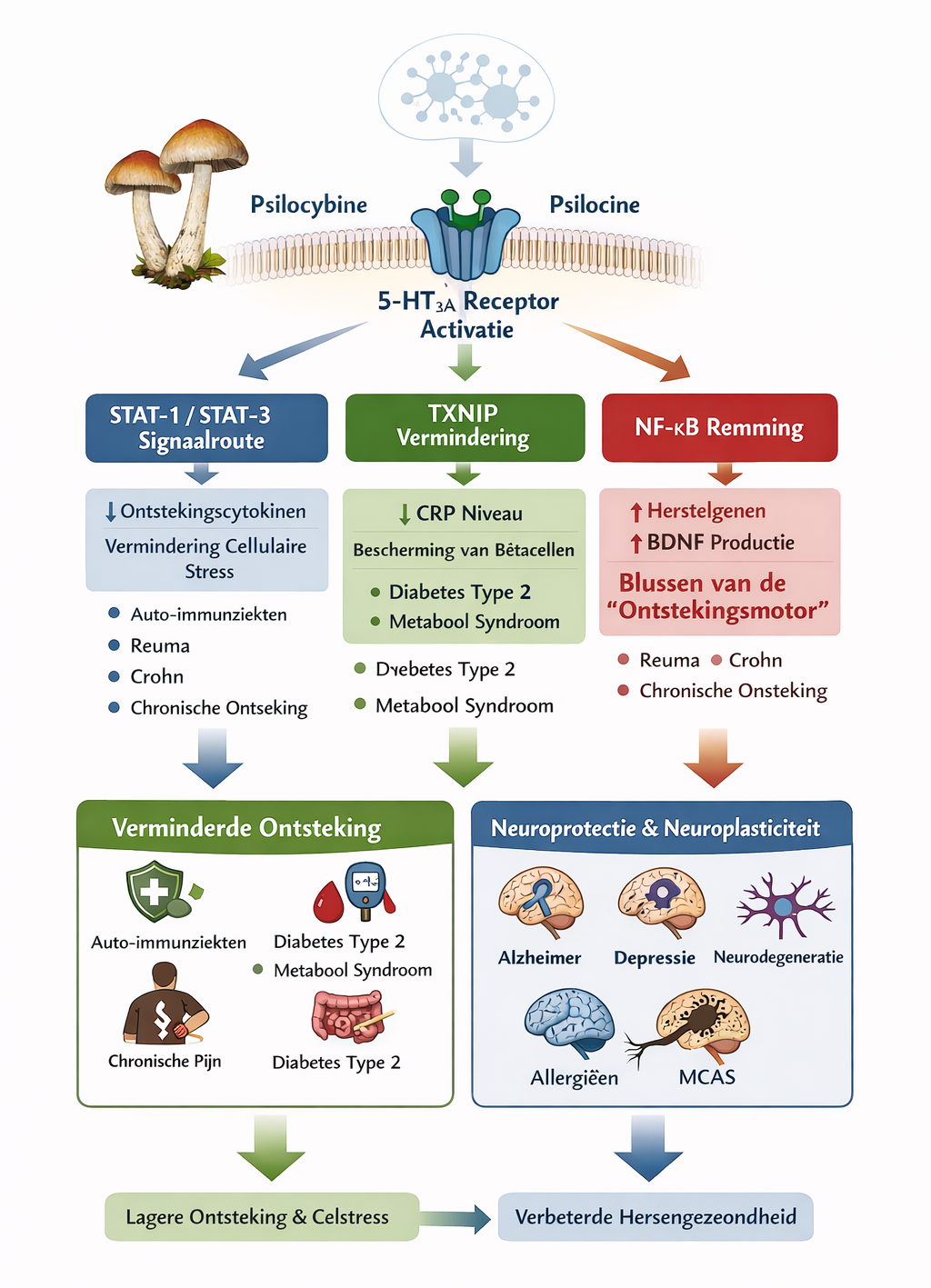
Summary Table: The Power of Psilocybin:
Posted : 6 February 2026 10:46
Topic starter
Psilocybin for diabetes still needs to be thoroughly investigated. In neurodegenerative disorders, psilocybin has a greater chance of being effective.
Posted : 20 February 2026 08:44