
Topic starter
Neurodegenerative disorders and BDNF
Alzheimer's, Parkinson's, and Huntington's disease are neurodegenerative disorders; in other words, the associated symptoms of these diseases are the signs of the deterioration of neurons in the brain. Reduced levels of BDNF are often measured in these patients. BDNF is a neurotrophin that ensures the creation of new brain cells and also facilitates their repair. BDNF stands for Brain-Derived Neurotrophic Factor. Neurotrophins are therefore important for the survival, repair, and growth of neurons. Neurons are nerve cells that process, transmit, or process information in the brain or nervous system. Neurons can be seen as the data cables between parts of the brain and the body. An average body has approximately 100,000,000,000 neurons (100 billion).
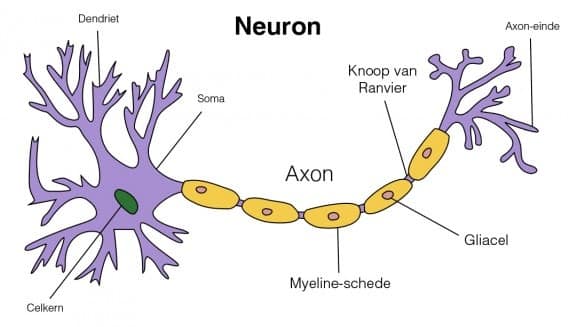
Too little BDNF
A deficiency of neurotrophins such as BDNF contributes to the development of neurodegenerative disorders. The lack of BDNF prevents neurons from repairing damage. This can lead to the development of Alzheimer's, Parkinson's, and/or Huntington's disease. Furthermore, depression can occur when there is insufficient BDNF present for an extended period. The degeneration of neurons in the frontal lobe appears to be the culprit here. Additionally, low serotonin levels contribute to depression. The depression is exacerbated because low serotonin levels, via the 5HT2A receptor, prevent sufficient BDNF from being released (see also the image below and bear in mind that the 5-HT receptor is not stimulated, or only minimally stimulated).
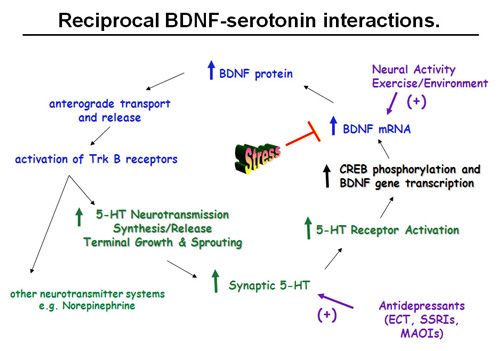
More BDNF
Producing more BDNF is therefore possible by stimulating the 5HT2a receptor. When the body releases more BDNF, it flips a switch on a series of genes that allow brand-new brain cells and nerve cell connections to grow. Slightly higher BDNF levels ensure that you learn faster, remember better, age more slowly, and that your brain rapidly rearranges connections with the various parts of the brain and the body.
BDNF also increases the plasticity of your brain. When your brain cells are damaged or find themselves in a stressful situation, BDNF protects them and helps them come back stronger. The neural pathways become more flexible instead of breaking down, which could explain why higher levels of BDNF are associated with warding off depression. Furthermore, increasing BDNF may potentially ensure that diseases such as Parkinson, Alzheimer and Huntington be reduced.
Psilocybin and LSD for Alzheimer's, Parkinson's, and Huntington's disease
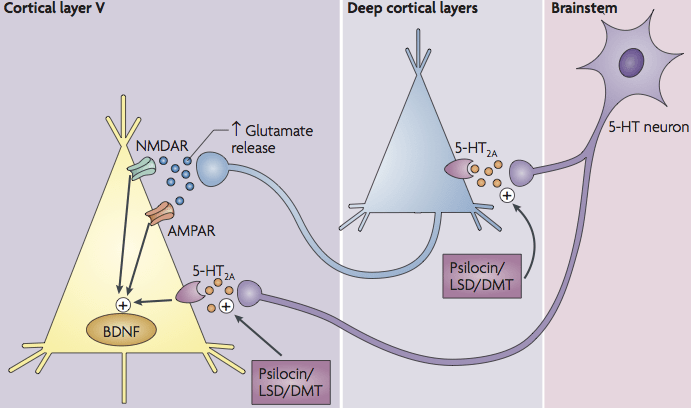
The highest possible stimulation of the 5HT2a receptor can be achieved with high doses of the psychedelics psilocybin and LSD. Psychedelics increase BDNF production and neurogenesis via the 5HT2a receptor. This explains why so many studies have recently emerged regarding psychedelic-assisted therapy that helps with depression and PTSD. We also expect more research into neurodegenerative disorders in the near future, including MS.
Read more here about the ongoing studies into psilocybin
Want to try a psychedelic session for neurodegenerative disorders right now?
We have been offering psychedelic sessions for years, particularly for the treatment of depression. Occasionally, due to encouraging reports, clients with neurodegenerative disorders also come to us for a guided session. In addition to increasing BDNF, we use the session to resolve any blockages in the subconscious. This allows us to reduce stress, which in turn has a positive long-term impact on health. However, individuals with neurodegenerative disorders sometimes take medication that does not interact well with or is even dangerous in combination with psychedelics. We check whether the medication being used is compatible based on an intake form. Are you interested? Fill out the intake form or contact us.
Posted : 19 May 2022 16:58
Loes reacted
Topic starter
Three years after the creation of this article, there is an increasing amount of scientific research confirming that psilocybin may well help with Alzheimer's. Here is a brief update on ongoing studies and mechanisms of action:
Alzheimer's is a progressive neurodegenerative disorder and the most common cause of dementia worldwide. Current drug treatments, such as acetylcholinesterase inhibitors and NMDA receptor antagonists, offer only temporary relief. There is no curative therapy yet. The search for more effective treatment options has led to innovative research into psychedelic substances, including psilocybin.
Psilocybin, known from magic truffles, is converted into psilocin in the body. This substance activates the serotonin 5-HT₂A receptor, which affects intracellular pathways such as the BDNF and mTOR signal path sets in motion. This activation stimulates neuroplasticity, synaptic growth, and neuritogenesis — processes that are essential for brain repair in neurodegenerative disorders such as Alzheimer's.
Within Triptherapie, the role of psilocybin in neurodegeneration has been studied for some time. This blog about psilocybin and LSD in Alzheimer's, Parkinson's, and Huntington's disease describes how elevated BDNF levels contribute to neuronal survival and the reduction of inflammation in the brain. Also on the Tripforum Users share that psilocybin appears to have a protective influence on cognitive functions via BDNF and 5-HT2A stimulation.
Scientific research supports these insights. At the Vrije Universiteit Brussel, psilocybin is being investigated in an Alzheimer's mouse model for its effect on BDNF production and neuroinflammation. In addition, clinical studies are underway, such as the Johns Hopkins pilot (NCT04123314) and a randomized trial by the Alzheimer's Drug Discovery Foundation (NCT06041152), in which cognitive improvement and synaptic density are being investigated, respectively.
The mechanisms of action appear promising: psilocybin inhibits overactive microglial cells (inflammation inhibition) and alters brain networks such that functional connectivity within the Default Mode Network decreases, while the salience and central executive networks become more active.
1. Inflammation inhibition via microglia:
Microglial cells are the immune cells of the brain. Under healthy conditions, they protect neurons, but in Alzheimer's, these cells are often overactive. They then actually cause damage by secreting inflammatory substances, which contributes to neuronal breakdown. Psilocybin has been shown to be able to inhibit this overactivity, thereby reducing neuroinflammation in the brain. This creates a more favorable environment for brain cells to survive and potentially recover.
2. Rearrangement of brain networks:
Psilocybin also influences the way different parts of the brain communicate with each other — we call this functional connectivity. One of the most striking effects is that the activity within the so-called Default Mode Network (DMN) decreases. This network is highly active during daydreaming, self-reflection, and worrying thoughts, but in Alzheimer's often becomes overactive or, conversely, dysregulated.
At the same time, activity in other networks is being strengthened, such as the Salience Network (that helps recognize relevant stimuli) and the Central Executive Network (which is involved in goal-directed thinking, memory, and concentration). By restoring the balance between these networks, cognitive functions such as attention, flexibility, and emotion regulation appear to improve.
In summary:
Psilocybin may work on two fronts in Alzheimer's:
-
It protects the brain by reducing inflammation.
-
It restructures brain connections so that thinking, feeling, and behavior are better aligned.
This combined action makes psilocybin such an interesting candidate in research into Alzheimer's therapy — not as a symptom reliever, but as a potential process changer.
Are you interested in the therapeutic possibilities of a psilocybin session or truffle session in the context of cognitive complaints or Alzheimer's? Then it is advisable to first a intake form to complete so that we can assess whether a session is safe and meaningful.
Posted : 27 May 2025 09:14