
Topic starter
Psilocybin works better than a nicotine patch for smokers.
Original content:
Based on the above new article and research on whether psilocybin can help with quitting smoking:
Anyone searching for magic mushrooms and truffles to quit smoking will soon come across psilocybin. Psilocybin is being taken increasingly seriously, particularly in the context of smoking addiction, because while many classic methods offer some relief, their long-term success is often limited. This makes this new comparative study interesting, as it did not compare psilocybin to a placebo, but rather to an existing and accepted treatment: nicotine patches, both combined with the same cognitive behavioral therapy program.
New study on psilocybin for smoking cessation
The study was conducted at Johns Hopkins Bayview Medical Center in Baltimore and published in JAMA Network Open in March 2026. It involved a randomized pilot study with 82 psychiatrically healthy adult smokers. The average age was 47.6 years, participants smoked an average of 15.7 cigarettes per day, and had a median of six previous attempts to quit. Of the 82 participants, 42 were placed in the psilocybin group and 40 in the nicotine patch group.
Both groups received a complete 13-week, manually developed CBT program for quitting smoking. This is important, because the effect was therefore not investigated independently of guidance. On the target quit date in week 5, the psilocybin group received one high dose of psilocybin of 30 mg per 70 kg of body weight. The nicotine patch group started an FDA-approved nicotine patch schedule of 8 to 10 weeks on that same quit day, with heavier smokers starting at 21 mg per day, then tapering to 14 mg and subsequently 7 mg.Triptherapie)
The primary outcome measure was biochemically confirmed long-term abstinence after six months. The researchers therefore did not rely solely on self-reported information from participants, but verified abstinence using, among other methods, exhaled carbon monoxide and urinary cotinine. Furthermore, the analysis was performed according to the intention-to-treat principle, meaning that dropouts or unreachable participants were counted as non-abstinent. This makes the results methodologically stronger.
Psilocybin worked better than nicotine patches in this study.
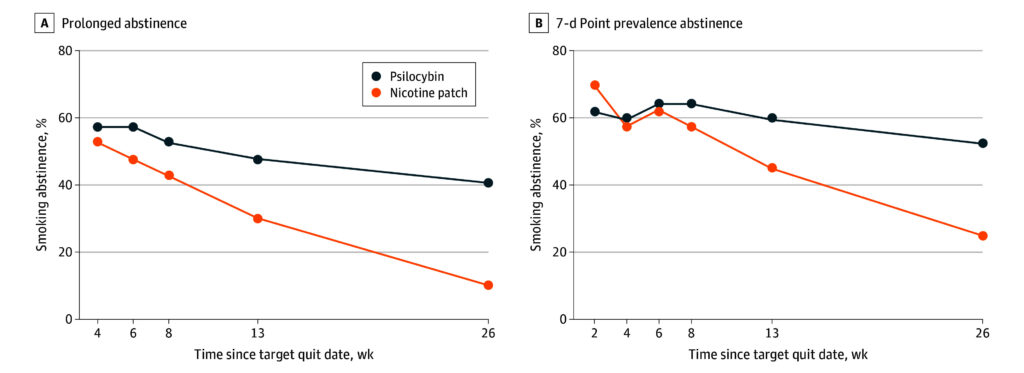
After six months, 40.5 percent of the psilocybin group was found to be biochemically confirmed to be smoke-free for a long period, compared to 10.0 percent in the nicotine patch group. For 7-day point prevalence abstinence, this was 52.4 percent versus 25.0 percent. Statistically translated, this amounted to an odds ratio of 6.12 for long-term abstinence and 3.30 for 7-day abstinence in favor of the psilocybin group. Furthermore, there were no serious side effects attributed to either psilocybin or nicotine patch.PubMed)
The psilocybin group also scored better on daily cigarette use between the quit date and six months later. The model estimated an average of 1.69 cigarettes per day for the psilocybin group compared to 3.64 for the nicotine patch group, which amounts to approximately 53.7 percent less. Even right after the quit day, a difference was already visible, as on the day after the target quit date, 90.5 percent of the psilocybin group reported not having smoked for at least 24 hours, compared to 80 percent in the nicotine patch group.
What makes this particularly interesting is that the nicotine patch group did not perform unusually poorly. The original piece explains that the outcomes of the nicotine patch group actually align reasonably well with the literature, meaning the lead of psilocybin can be taken more seriously. Therefore, this is not an unrealistically poor comparison, but a comparison with a credible standard approach.
Why this study is impressive, but is not yet the last word
This study is impressive because it was directly compared to an existing treatment, because both groups received CBT, because abstinence was biochemically controlled, and because dropouts were not removed from the analysis. At the same time, one must be honest about the limitations. It was a pilot study, the study was not blinded, and the participants were psychiatrically healthy, predominantly white, relatively often highly educated, and remarkably often had prior experience with classical psychedelics. As a result, generalizability is limited.
There is another important point. The psilocybin group also received more contact time in the trajectory, a median of 29.6 hours compared to 16.8 hours in the nicotine patch group. According to the authors, this difference was primarily due to the 8 to 9-hour psilocybin day and the debriefing the following day. This means that part of the benefit may stem not only from the substance itself, but from the combination of intensive experience, extra therapeutic attention, and meaning-making. This is particularly relevant when viewing smoking addiction as something that requires more than just symptom management.
What this study means for the Triptherapie vision
This smoking cessation study aligns well with how Triptherapie has long viewed addiction. The original article links this to the idea that psilocybin, after conversion to psilocin, binds to 5HT2 receptors and that stimulation of 5HT2A is associated with more BDNF, more new connections, and more room for new choices. Additionally, it is emphasized that preparing for a session is much more important than people often think, because preparation influences the psyche, neurochemistry, the body, and ultimately the outcome of the process.
The core question, then, is not only whether psilocybin works, but also how best to prepare someone for lasting change. This is where supporting factors come into play. Not as a replacement for psilocybin, nor with the same level of evidence, but as potential enhancers of calm, resilience, stress regulation, and sustainability. That is precisely the holistic approach elaborated in the original article.
What else can you do?
At Triptherapie, smoking addiction is not approached solely as a nicotine problem, but as an interplay of habit, stress, anxiety, neurochemistry, and coping. Therefore, the original piece advocates for synergy between psychedelics, lifestyle coaching, talk therapy, supplements, preparation, and integration. The idea is not that individual supplements replace a full-fledged smoking cessation treatment, but that they can contribute as a supporting layer to more calm, less tension, and a more stable foundation for change.
GABA as an inhibitory counterpart to restlessness and craving
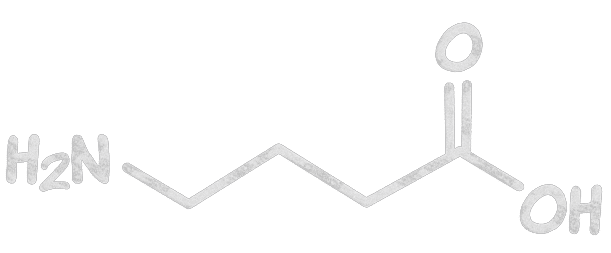
GABA is described in the original article as an inhibitory neurotransmitter that can help with hyperactivity, tension, anxiety responses, relaxation, and sleep. That makes GABA Substantively relevant for people who smoke not only for nicotine, but also to quell inner restlessness. Along the same lines, it is explained that nicotine affects not only dopamine, but also glutamate and GABA in mesocorticolimbic circuits, and that increased GABA transmission or decreased glutamate transmission may potentially reduce the rewarding effect of nicotine and cue-induced nicotine seeking.
This does not yet prove that a GABA supplement is an effective smoking cessation treatment in itself. However, the GABA pathway is presented in the original article as a logical supporting layer. Practical ways to improve GABA function are also mentioned, such as diet, supplements, walking in nature, meditation, cuddling, music, and dance. At the same time, a warning is issued to be cautious with combinations involving benzodiazepines, barbiturates, antidepressants, or alcohol.
B6 as a possible supplement for more anxiety reduction
Vitamin B6 is mentioned in the original article because it is involved in the synthesis of GABA. Reference is made to a double-blind, placebo-controlled study in young adults in which 100 mg of vitamin B6 daily for 30 to 35 days led to reduced self-reported anxiety and provided evidence of greater inhibitory GABAergic influence. This is not a smoking cessation study, but it is considered biologically relevant for people whose smoking behavior is strongly associated with tension or anxiety.
The nuance is important. The step from less anxiety to less urge to smoke remains a hypothesis and not a proven causal line. Nevertheless, B6 fits within the broader model in which strengthening the inhibitory side of the nervous system potentially makes someone less dependent on nicotine as a sedative.
Arginine as a possible enhancer of GABA
Arginine is mentioned in the original article via a 2002 animal study, which investigated whether L-arginine could increase the permeability of the blood-brain barrier to GABA via nitric oxide. In that study, GABA and L-arginine each increased brain GABA separately, while the combination resulted in a much larger increase. Additionally, human research is mentioned in which L-lysine plus L-arginine together appeared to reduce stress and anxiety sensitivity.
Here too, it holds true that this is not direct evidence for quitting smoking, nor for arginine as a standalone intervention. In the original piece, arginine is therefore primarily positioned as possible support in the preliminary phase, especially for people who smoke due to nervousness, alertness, or an agitated system. The level of evidence in this regard is clearly lower than for psilocybin.
DHEA as a factor in stress, negative affect, and relapse
DHEA and DHEAS are described in the original article as substances that likely indicate something about stress resilience, mood, and the likelihood of relapse. In smokers, higher DHEAS levels are said to be associated more frequently with fewer feelings of sadness or tension and less nicotine craving. It is also mentioned that the ratio between DHEA and cortisol during smoking cessation may say something about the risk of relapse in the initial period without cigarettes.
The strongest argument for DHEA The original piece refers to research in people with multiple co-occurring addictions, in which participants received 100 mg of DHEA or a placebo daily for a month. The DHEA group felt less negative during the treatment and re-used addictive substances less frequently in the months that followed. This did not specifically concern smoking, but it is mentioned as an indication that DHEA may be relevant to stress, mood, and relapse susceptibility related to smoking addiction.
Combine everything with lifestyle changes
An important part of the original article is that lifestyle is not viewed as a secondary matter. According to the text, Triptherapie also involves balancing neurochemistry through nutrition, supplements, and practical advice tailored to the individual's situation. Neurotransmitters such as GABA, serotonin, dopamine, and acetylcholine are mentioned in this context, with the aim of making the nervous system calmer and more stable.
Precisely such a more stable foundation can make someone less likely to reach for nicotine when experiencing stress, anxiety, or fatigue. The goal is not to replace smoking with lifestyle changes alone, but to reduce the underlying vulnerabilities. Those who sleep better, experience less energy fluctuation, feel more calm, and recover better emotionally simply have a greater chance of permanently letting go of old patterns.
Conclusion
Mushrooms and truffles to quit smoking may sound sensational, but the substance behind them is more serious than many people think. Based on this pilot study, psilocybin currently provides a strong scientific signal regarding smoking addiction, stronger than nicotine patches within this comparative design. At the same time, the overall picture also shows that preparation, guidance, finding meaning, and integration likely account for a significant part of the effect.
The fairest conclusion, therefore, is not that all the mentioned components together are already established as a single, proven, fixed treatment. What one can say, however, is that together they form a logical and substantively strong whole. GABA is particularly associated with more calm and less restlessness, B6 possibly with supporting GABA, arginine with stress and inhibition, DHEA with mood and relapse, and lifestyle coaching with a more stable neurochemical basis. Within that whole, psilocybin is the component with the strongest direct indication of effectiveness.
Use our protocol
Therefore, Triptherapie does not work solely with a session in itself, but with a protocol in which safety, intake, lifestyle, neurochemical balance, intention, guidance during the session, and integration come together. According to the original article, this is particularly suitable for people who not only want to stop temporarily, but also want to understand why the addiction developed and how a new direction can be better sustained.
Anyone wishing to utilize a Triptherapie protocol for addiction or smoking addiction can sign up for an intake to determine which form of guidance suits them best. The original document also refers to the schedule for group sessions, the schedule for private sessions, and contact options, so that individuals can determine which path best aligns with their own situation.
Reviews about addiction
The original article concludes with real-life stories, precisely because relatable experiences resonate more with many people than theory alone. Nine examples are listed, including stories about a clear reset towards a healthier life, two MDMA sessions resulting in lasting change, a truffle ceremony regarding alcohol addiction, an individual session to break habits, a home session focusing on preparation and safety, a remarkable experience with Janneke, a first truffle session, an experience from someone seeking answers through psychedelics, and a review from someone who quit smoking after twenty years following a second session with Marcel.
It is precisely these real-life stories that underscore the central message of the piece. A breakthrough usually does not occur through a single isolated moment, but through the combination of preparation, lifestyle, guidance during the session, and integration into daily life. That is exactly why magic mushrooms and truffles are not presented as a standalone tool in this context, but as part of a broader process of change.
See here the reviews involving addiction
Posted : 25 March 2026 11:15