
Topic starter
In a recent double-blind study, 2C-B (10, 20 and 30 mg), 125 mg of MDMA and 25 mg of psilocybin were directly compared in 24 healthy participants.
The figures with time scales below clearly illustrate how strongly and for how long people feel the effects of the substance, which effects are perceived as pleasant or unpleasant, and how anxiety, nausea and social feelings develop.
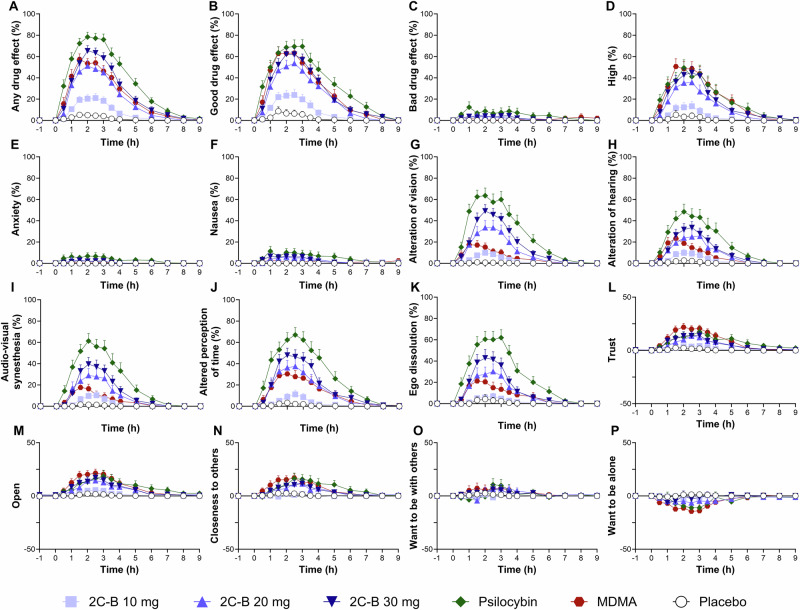
To what extent do people actually “feel anything at all”?
Panel A (“any drug effect”) shows the overall intensity: the extent to which a person notes that a remedy works, without this necessarily being a good or bad thing.
Psilocybin scores highest here; people therefore feel the effects of psilocybin most distinctly, followed by 2C-B at 30 mg and MDMA just below that, whilst lower doses of 2C-B and the placebo remain significantly lower.
Beneficial vs. adverse effects
In Panel B (“good drug effect”), you can see that the desired, pleasant effects are strongest with psilocybin, followed by 2C-B 30 mg and MDMA, with lower scores for 2C-B 10 and 20 mg and virtually no effects with the placebo.
Panel C (“bad drug effect”) shows that psilocybin also produces the most adverse effects; in this study, only psilocybin caused clear “bad drug effects” and anxiety compared with placebo, which is likely linked to its strong and prolonged intensity.
Feeling “high”: MDMA vs. psilocybin
Panel D (“high”) illustrates the sensation of being genuinely “high”.
In the first part of the experience (roughly the first hour), MDMA levels are often slightly higher than those of psilocybin, but after about two hours the curves converge and the peak levels are, on average, comparable, whilst psilocybin’s effects last longer.
Anxiety and nausea
Panel E (“anxiety”) and panel F (“nausea”) show that psilocybin is most strongly associated with anxiety and nausea.
In second place, for both outcome measures, you can see the higher 2C-B dose: 30 mg of 2C-B results in greater levels of anxiety and nausea than lower doses, but less than psilocybin, whilst MDMA remains relatively low on these scales.
Changes in perception and the self
Panels G to K show visual and auditory changes, altered perception and ego dissolution.
Here too, psilocybin stands out most clearly: the curves for changes in vision and hearing, altered perception and ego dissolution are highest and broadest for psilocybin, followed by 2C-B 30 mg, and then MDMA and the lower doses of 2C-B.
Social emotions: openness, closeness and the desire to be alone
Panels M, N and O relate to openness, “closeness to others” and “wanting to be with others”, whilst panel P reflects “wanting to be alone”.
MDMA and 2C-B (30 mg) primarily increase openness and a sense of closeness to others, whilst psilocybin also has positive effects in this regard but, at this dose, may simultaneously lead to a greater tendency towards withdrawal and introspection, which is reflected in a slightly higher “want to be alone” tendency than with MDMA.
Positive, adverse and perceptual effects: 2C-B vs. MDMA vs. psilocybin
In addition to the moment-to-moment graphs, standardised questionnaires were also used to positive, distress‑ (difficult) and perceptual securities and mystical/spiritual experiences to measure.
The bar charts below in the new figure show exactly how 2C-B doses, MDMA and psilocybin compare in this respect.
Positive Effects (PoSE)
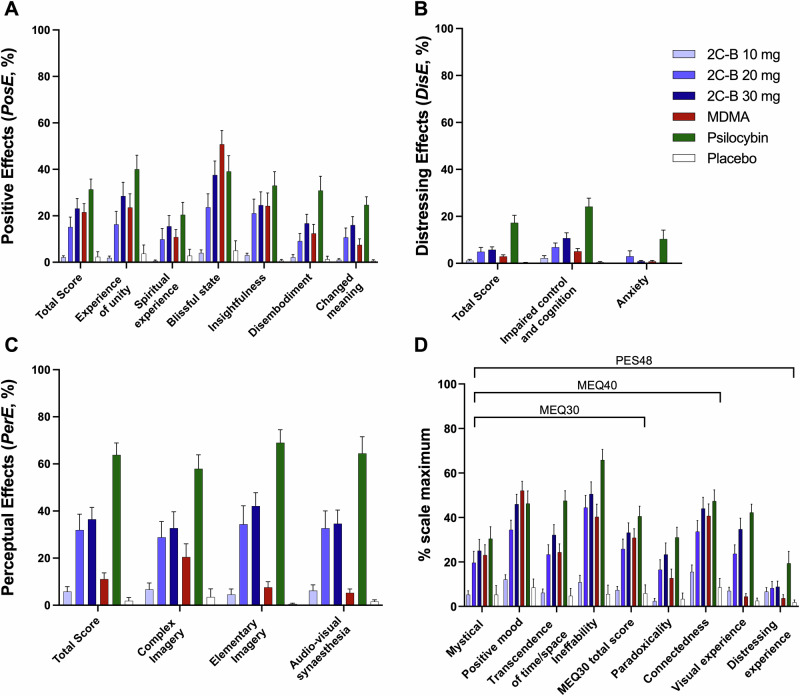
Panel A shows the Positive Effects (PoSE): total positive score, sense of unity, spiritual experience, blissful state, insight, disembodiment and changed meaning.
Psilocybin scores highest on virtually all positive subscales: in particular, ‘blissful state’, spiritual/oneness experiences and insight stand out, whilst 2C-B 30 mg scores below these and MDMA scores even lower.
Distressing effects (DiSE)
Panel B shows Distressing Effects (DiSE): total distress score, impaired control and cognition, and anxiety.
Here you can see that psilocybin also produces the highest distress scores and anxiety, followed by 30 mg of 2C-B; MDMA and the lower doses of 2C-B remain significantly lower and are closer to the placebo.
This is consistent with the time-course graphs showing that psilocybin caused the most anxiety, nausea and “bad drug effects”, with 30 mg of 2C-B coming in second place.
Perceptual effects (PerE)
Panel C shows Perceptual Effects (PerE): total perceptual score, complex imagery, elementary imagery and audiovisual synesthesia.
Psilocybin is once again clearly dominant here: it produces the most pronounced visual and sensory changes, including complex inner imagery and audiovisual synaesthesia, with 30 mg of 2C-B in second place and MDMA and lower doses of 2C-B producing much more subtle effects.
Mystical and spiritual experience (MEQ, PES)
Panel D combines various mystical experience scales (MEQ30, MEQ40, PES48) and sub-scales such as ‘mystical’, ‘positive mood’, ‘transcendence of time/space’, ‘ineffability’, ‘connectedness’, ‘visual experience’ and ‘distressing experience’.
Here too, psilocybin scores highest on most mystical and spiritual dimensions, with a strong positive mood, a sense of transcendence and connectedness, whilst 2C-B 30 mg once again occupies a middle position (clearly above MDMA, but below psilocybin) and MDMA remains relatively lower on the classic “mystical experience” scales.
Conclusion
In summary: in this setting, psilocybin produces the strongest and most pronounced a combination of positive, mystical and perceptual effects, but also the greatest fear and distress, which is partly due to the higher intensity and longer duration.
2C-B 30 mg is a type of hybrid profile: less intense than psilocybin in terms of anxiety and intensity, but clearly psychedelic and mystical, and with entactogenic/mind-opening properties that are closer to those of MDMA.
Addition
One interesting idea is that the strengths of MDMA and psilocybin may complement one another. Psilocybin seems to evoke the deepest, most mystical and most meaningful experience of all, but at higher intensities it is also more likely to be accompanied by anxiety, nausea and difficult moments.
MDMA, on the other hand, is known for increasing emotional openness, a sense of connection and empathy, and for reducing anxiety and feelings of social threat
It is precisely for this reason that it is conceivable that, in certain combinations, MDMA might make the psilocybin experience gentler, safer and more emotionally accessible, without the experience losing any of its depth.
At Triptherapie, we have supported many people who have a did a ‘hippieflip’, combining MDMA with psilocybin. Based on these experiences, we regularly find that this combination can lead to greater relaxation, greater emotional surrender and less resistance when entering the psychedelic process.
At the same time, caution remains important, as combining treatments also increases the complexity, the physical strain and the unpredictability of the course of the condition.
Posted : 29 June 2026 17:05