
Topic starter
In discussions about psychedelic sessions with hallucinogenic substances (LSD, psilocybin, DMT, ayahuasca), it sometimes seems as if only two options exist. On the one hand, there is the idea that profound change is only possible when psychedelics are combined with intensive psychotherapy. On the other hand, there is the notion that guidance is hardly necessary and that the substance does all the work itself. The reality usually lies somewhere between those two extremes.
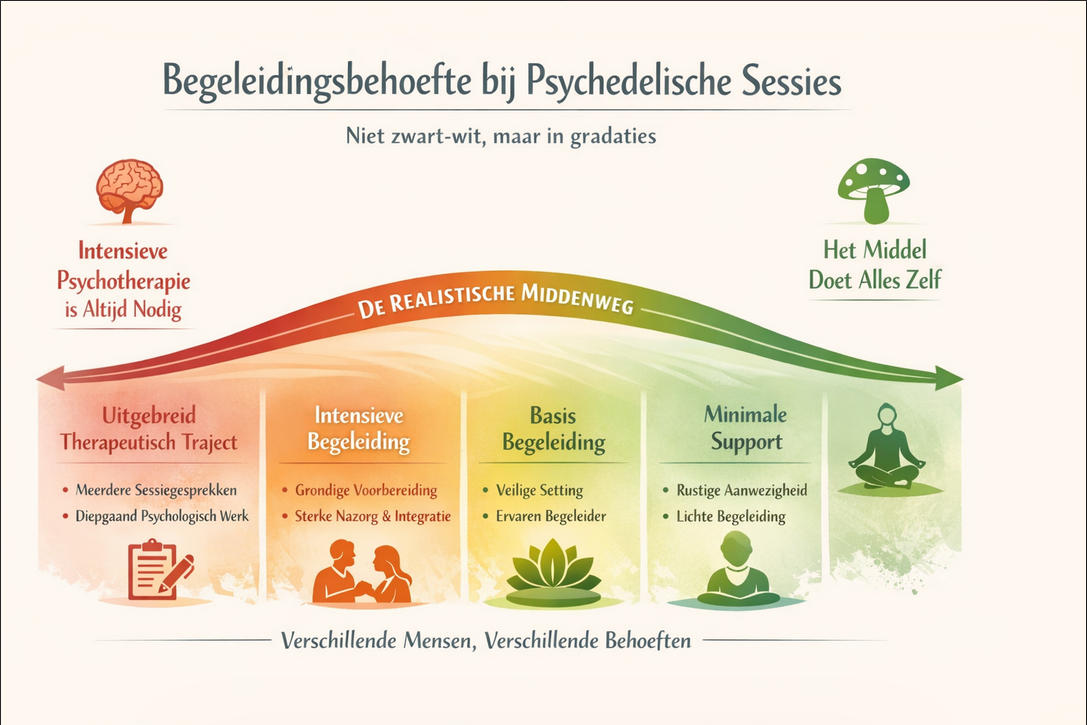
Especially with psychedelic sessions, it is more sensible to think in terms of gradations of guidance needs. Not everyone requires the same preparation, not everyone experiences a session in the same way, and not everyone needs the same amount of support to translate insights into daily life. For one person, a quiet, safe setting with an experienced guide is sufficient. For another, more preparation, more attunement, and more integration are desirable. This does not make psychedelic guidance weaker, but rather more realistic.
Why the debate is often conducted in too black-and-white terms
The discussion often revolves around the question of whether Psychotherapy is needed for psychedelic sessions to be effective. That is understandable, but the question is also formulated too broadly. For what exactly do we mean by psychotherapy, and what do we mean by guidance?
A classic psychotherapeutic approach usually consists of a treatment relationship involving multiple sessions, clear therapeutic goals, a chosen method, and active psychological interventions. Psychedelic guidance may partially resemble this, but it does not necessarily have to. There are also pathways where the emphasis lies on screening, preparation, trust, safety during the session, and a thorough debriefing, without the session itself consisting primarily of talking and therapeutic interventions.
There are all kinds of middle ground between these extremes. It is precisely these middle ground paths that are often chosen in practice, because they align better with what psychedelic experiences naturally evoke. During a deep session, a person is often less focused on conversation and analysis, and more on feeling, allowing, experiencing, and processing. In such a deep session, intensive psychotherapy does not always have to play the leading role to still enable valuable change.
What recent research on this shows
A recent publication in the Journal of Affective Disorders examined the relationship between therapeutic alliance, the nature of the psychedelic experience, and clinical outcome in people with treatment-resistant depression who received 25 mg of psilocybin in a controlled research setting. In this analysis, the relationship between the pre-measured therapeutic alliance and the reduction of depressive symptoms was relatively weak. The subjective psychedelic experience, on the other hand, was clearly more strongly associated with the outcome.
That does not mean that guidance was unimportant. On the contrary, the same study showed that a better working relationship with the supervisor was indeed associated with certain aspects of the experience. The alliance thus appeared to be less of a direct driver of the outcome, and more of a factor that can help create a favorable experience. In other words, the experience itself seemed to be the strongest predictor of change, but the circumstances in which that experience occurred still played a role.
That is an important nuanced difference. The research does not support the proposition that guidance is superfluous. Rather, it supports the idea that the value of guidance is often indirect. Good preparation, trust, and a safe setting can influence the quality of the experience, while that very experience, in turn, is more strongly correlated with the final outcome.
What this means in practice
The practical lesson is that psychedelic sessions do not always require a heavy psychotherapeutic framework, but neither should they be reduced to merely taking a substance. Between these two poles lies a broad middle ground where many people benefit the most.
Some people primarily need peace, clarity, and safety. They want to know what to expect, want to enter the session well-prepared, and benefit most from a calm, experienced presence during the experience. For them, the guidance does not need to be very directive or intensive to still be of great value.
Others have a greater need for alignment beforehand. For example, because they enter with a lot of tension, struggle with surrender, have had difficult experiences in the past, or bring important life questions with them. In such cases, careful preparation can have a significant impact on how someone approaches the session. Not because the preparation explains the entire outcome, but because it lays the foundation upon which the experience unfolds.
There are also people who need more help with integration after the session. They may have had a profound experience, but find it difficult to translate it into concrete choices, behavior, or new patterns. Even then, support is relevant, not because the experience is worthless without those conversations, but because insight and application are not automatically the same.
Different support needs among different people
The idea that everyone needs the same form of guidance does not fit well with psychedelic sessions. The need for guidance depends on personality, life experience, psychological resilience, expectations, previous experiences with mind-altering substances, and the specific issue someone brings.
Someone who is emotionally stable, comes well-prepared, feels safe, and is already accustomed to inner work often finds a clear intake, good preparation, and calm guidance on the day itself sufficient. Another person may need more support to deal with tension, a need for control, or old themes. Yet another benefits primarily from a careful integration process afterwards.
That makes guidance tailored. Not everyone needs a full psychotherapeutic trajectory. Not everyone is satisfied with minimal support. The key is that the form of guidance suits the person, the intention, and the context.
Why a safe middle ground often fits best
A safe middle ground acknowledges two things simultaneously. First, that the psychedelic experience itself often sets a large part of the movement in motion. Second, that the setting, preparation, and guidance can indeed support that experience.
That middle ground also prevents two common mistakes. The first mistake is overestimating psychotherapy, as if change can only occur when every psychedelic session is embedded in an extensive therapeutic model. The second mistake is underestimating guidance, as if presence, safety, and attunement make little difference.
In reality, an experienced facilitator can mean a great deal without constantly intervening actively. Sometimes the value lies precisely in stillness, non-verbal attunement, timing, maintaining safety, and being able to allow an experience to unfold without disrupting it. Especially in introspective sessions, where someone turns inward with music, an eye mask, and closed eyes, the emphasis is often not on conversation, but on creating circumstances in which the inner process can unfold.
Guidance is not always the same as psychotherapy
A significant part of the confusion arises because counseling and psychotherapy are often lumped together, even though the two are not identical.
Psychotherapy is a treatment method with a specific theoretical framework. Guidance during psychedelic sessions can be much simpler and at the same time very valuable. Consider the intake, preparation regarding biological health as well as psychological health, explanation, safety agreements, building trust, philosophical, spiritual, or theistic conversations, remaining present during the session, support where needed, and offering space for integration afterward. That is no small feat. However, it is also not by definition the same as a full psychotherapeutic treatment.
By making this distinction clear, the conversation becomes purer. Then we do not have to choose between “everything is psychotherapy” and “nothing regarding guidance matters.” Then we can say more honestly that psychedelic sessions sometimes function excellently within a model of careful, appropriate guidance, without intensive psychotherapy necessarily having to be the core.
Why definitive statements often fall short
It sometimes sounds appealing to say that psychotherapy is not necessary for psychedelic sessions. Such a statement sets itself apart from an overly narrow or overly medical view of psychedelics. However, that phrasing is easily too assertive, although it is useful for getting people to think. For for some people, additional psychological support is indeed beneficial, sometimes beforehand, sometimes afterwards, and sometimes in combination with the session itself.
It is equally too assertive to claim that psychedelic sessions without an extensive therapeutic framework have little value. The available literature, including recent research into therapeutic alliance and experience, actually indicates that subjective experience often carries significant weight. This means that not every effective element needs to be reduced to classical talk therapy.
A good option is to allow multiple possible structures to coexist. Not everyone needs the same method. And not every process needs to meet the same definition to be thorough and meaningful.
A more realistic way to look at psychedelic sessions
A more realistic picture is therefore this: psychedelic sessions can stir up a lot through the experience itself, but that experience does not arise in a vacuum. Preparation, trust, safety, setting, and appropriate guidance all influence how someone enters the session and how the experience is perceived and processed.
Sometimes minimal direction during the session is actually appropriate. Sometimes more attunement is needed. Sometimes the greatest added value lies beforehand. Sometimes it lies precisely in the integration afterwards. Guidance does not always have to be intensive psychotherapy to still be of great significance. At the same time, acknowledging the power of the experience does not mean that we trivialize guidance.
That middle area might be less spectacular than a sharp position, but it aligns better with practice.
Finally
The recent research adds valuable nuance to the debate. The outcome appears to correlate more strongly with the nature of the psychedelic experience than with the pre-measured therapeutic alliance. At the same time, the same analysis shows that this alliance may help shape the experience. This creates a nuanced picture: not psychotherapy as the sole key, but neither is guidance a secondary matter.
For psychedelic sessions, it is therefore more sensible not to ask whether guidance is needed or not, but rather what kind of guidance is appropriate in which situation. That is precisely where the middle ground lies that does justice to differences between people, to the power of the experience, and to the importance of safety, preparation, and integration. At Triptherapie, we certainly have a solution for a lot of people. For example, we have multiple therapists, tripsitters and protocols that we can use to get close to the support needs.
Posted : 14 April 2026 09:21