
Topic starter
A striking story has been going around the psychedelic world for a while now: people, under the influence of DMT, are said to look at a laser pattern and see text, symbols or some kind of “code of reality” in it. The idea captures the imagination, as it suggests that there might be a hidden layer behind the visible world, as if reality itself is made up of information or programming language.
The best-known example of this is the so-called “Code of Reality”-experiment by Danny Goler. In an article in IPI Letters describes that people under the influence of N,N-DMT look at a diffracted light pattern from a 650 nm laser, reporting recurring geometric structures and symbols resembling “code”. The article itself calls this a pilot study, i.e. an early exploratory description, not definitive proof of a hidden layer of information in reality.
What exactly is claimed?
The crux of the claim is that different people under the influence of DMT would see similar symbols or text-like patterns when looking at a specific laser pattern. According to some proponents, this could indicate that the perceived code does not just come from the brain, but reveals something objective about the structure of reality.
That's a big jump. Just because people report something similar does not automatically mean they see an external code. People have similar brains, similar senses, similar cultural references and often similar expectations when they embark on such an experiment. Especially when someone hears beforehand that there would be “code” to see, expectation can play a big role.
The sober explanation: pareidolia
A much simpler explanation is pareidolia. Pareidolia is the phenomenon where the brain sees recognisable shapes in random or ambiguous stimuli. Think of faces in sockets, animals in clouds, figures in wood grains or faces in spots. Merriam-Webster describes pareidolia as the tendency to perceive a specific, often meaningful image in a random or ambiguous visual pattern.
With a laser pattern, something similar can happen. A laser, especially when the light is scattered or diffracted, can produce complex patterns. To the eye, this is not neutral information, but a visual field full of lines, noise, contrast and repetition. The brain automatically tries to find order in that.
Why exactly text or code?
That people see “text” or “code” is not surprising. Text is one of the most learned forms of pattern recognition in our daily lives. We see letters, numbers, symbols, screens, keyboards, logos, subtitles, apps and digital interfaces all around us all the time.
The brain is therefore highly trained to interpret small differences in lines, angles, curves and rhythms as letters or symbols. So when you see an ambiguous visual pattern, especially under the influence of a powerfully altered state of consciousness, it is not surprising that the brain recognises script-like shapes in it. Not because there is literal text there, but because the brain is trying to convert visual uncertainty into something familiar.
Psychedelics can enhance meaning
DMT is known for evoking very intense visual experiences. In scientific research, at DMT among others, described vivid visual images, rapid changes in consciousness and markedly altered perception. For example, an EEG study of intravenous DMT mentions that the subjective effects come on very quickly and are characterised by strikingly vivid visual images.
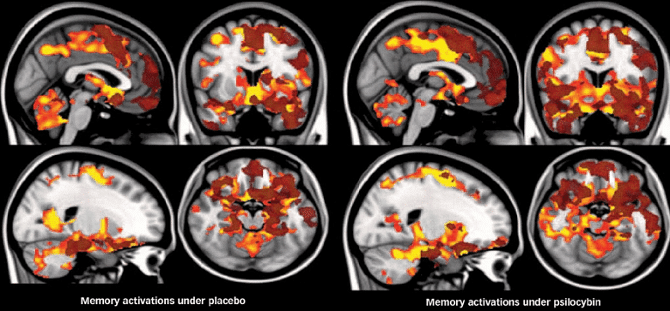
More broadly, serotonergic psychedelics such as LSD, psilocybin and DMT can also greatly alter the visual experience temporarily. Among other things, geometric figures, recurring patterns, visual illusions and more complex images can be experienced or seen at higher doses.
It is therefore important to distinguish between intensity and truth. An experience can feel extremely real, deep and meaningful, without the perceived content literally existing outside the brain. Psychedelics can alter not only seeing, but also the feeling that something is important, personal or cosmically relevant.
The need to understand
People are meaning makers. We find it hard to look at chaos without looking for a pattern in it. This is usually useful. It helps us recognise faces, understand language, assess danger and read social cues. But the same mechanism can also slip through.
When someone looks at a complex laser pattern under the influence of DMT, several factors come together: visual noise, heightened sensitivity to patterns, expectation, suggestion, fascination and the human need to understand something. Then it makes sense that an unclear pattern is perceived not as “noise” but as a “message”.
This does not mean that the experience is worthless. Someone may get something personal out of it, such as wonder, reflection or a new perspective on perception. But personal meaning is different from universal evidence.
The risk of jumping to conclusions too quickly
The DMT laser experiment is interesting as a phenomenon of consciousness, but it does not prove that there is literally a hidden code in reality. That would require much stricter controls. Think blinded design, comparisons with placebo, testing without prior suggestion, independent replication, objective recording of what people see and control conditions with people not using DMT.
Without such controls, the most likely explanation remains psychological and neurological: the brain interprets an ambiguous visual pattern and turns it into something meaningful.
Final conclusion
The “code” that people see in the DMT laser experiment probably comes not from a hidden universal truth, but from the way the brain processes information. Our brain constantly looks for patterns, recognition and meaning, even when the stimulus itself is random or ambiguous.
Pareidolia explains why people can see faces in sockets and animals in clouds. Under the influence of psychedelics, that same tendency can feel stronger, more intense and meaningful. Because text, symbols and digital code are so deeply ingrained in our perception and culture, it is not surprising that the brain also recognises something text-like in a laser pattern.
The experience may be personally impressive, but that does not make it evidence of an external message. Most likely, the DMT laser experiment shows how strong the human need is to understand and give meaning to information, even when there may be no meaning at all.
See also: What are psychedelic hallucinations?
Posted : 10 May 2026 15:31