
Topic starter
There is a new scientific article A study has been published on psilocybin in relation to chronic suicidal thoughts. This was an open-label study investigating a single 25 mg dose of synthetic psilocybin in people with long-term suicidal ideation and treatment-resistant depressive symptoms.
Why this study is special
Many psychedelic studies actually exclude people with clear suicidal thoughts. Whilst this is understandable for safety reasons, it means that little is known about the very group that may be in greatest need of rapid and carefully researched support. In this study, the researchers therefore set out specifically to investigate whether psilocybin, combined with intensive psychological support, can be safely studied in people with chronic suicidal ideation.
In the video, the researchers also point out that some people with suicidal thoughts have learnt to hide these symptoms. Being open about such feelings may previously have led to hospitalisation, a loss of autonomy or strain on relationships. As a result, this is not only a scientific study, but also an attempt to better understand a group that is often marginalised.
What were the researchers investigating?
The study was conducted among 20 adults with a depressive disorder and chronic suicidal thoughts. Participants had undergone at least two previous courses of antidepressant treatment which had proved insufficiently effective. People with an acute plan and immediate intention to commit suicide were excluded; the study therefore focused on chronic suicidal ideation without immediate intention.
All participants tapered off their psychotropic medication in advance under supervision. This was followed by three preparatory sessions with two specially trained therapists, including a psychologist. They were then given a single oral dose of 25 mg of COMP360, a synthetic form of psilocybin, in a comfortable treatment room. The session lasted approximately eight hours and was followed by integration sessions in the days and weeks that followed.
The results were striking
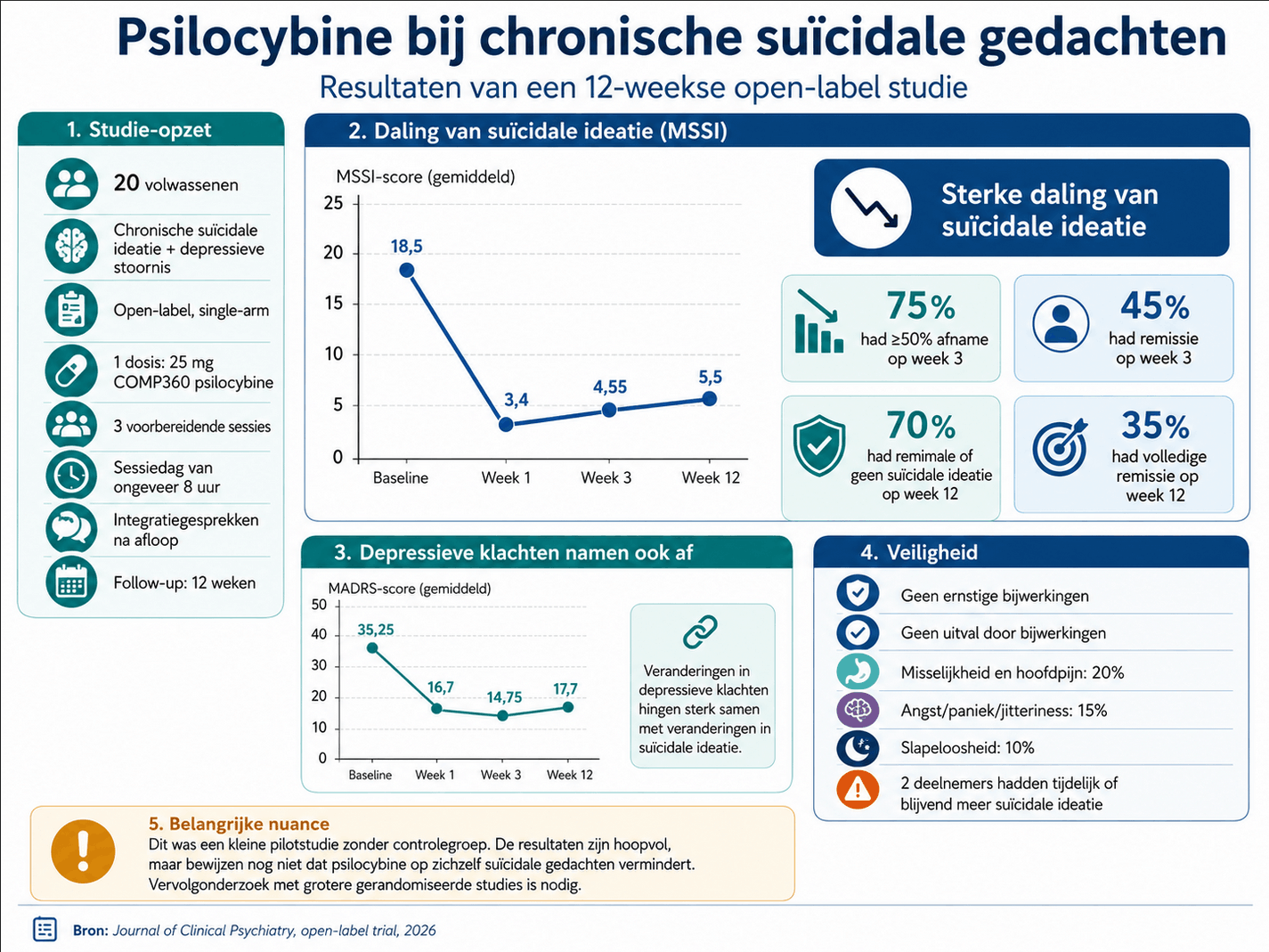
Suicidal ideation was measured using the Modified Scale for Suicidal Ideation, abbreviated to MSSI. The average score fell sharply following the psilocybin session. At baseline, the average MSSI score was 18.5. After one week, this was 3.4; after three weeks, 4.55; and after twelve weeks, 5.5.
At the primary assessment point in week 3, 75% of the participants showed a reduction in suicidal ideation of at least 50%. Furthermore, 45% were in complete remission according to the MSSI score at that time. After twelve weeks, 35% were in complete remission and a further 35% had minimal residual suicidal ideation. Taken together, this means that 70% had an MSSI score of 0 to 2 after twelve weeks.
Depressive symptoms also decreased. The MADRS score, a scale for measuring depressive symptoms, also fell significantly in week 1, week 3 and week 12. The researchers also observed that changes in suicidal ideation and depressive symptoms were strongly correlated.
Could it have a distinct effect on suicidal thoughts?
An interesting point is that the reduction in suicidal thoughts was already very evident in week 1. Depressive symptoms then appeared to improve even further as we approached week 3. The researchers therefore cautiously speculate that psilocybin-assisted therapy may not only work by reducing depression, but may also have a direct influence on factors such as hopelessness, entrenched beliefs and one’s outlook on the future.
This has not yet been proven. The study is too small for that, and there is no control group. However, this notion does tie in with the idea that psilocybin can temporarily increase mental flexibility, enabling some people to perceive their own future or situation as less fixed and hopeless.
Not everyone reacted well
The researchers describe the outcomes as roughly falling into three groups. Around one-third of the participants had a robust response that persisted until week 12 without antidepressant medication. A further one-third also had a clear response, but resumed medication between weeks 3 and 12. The remaining third did not respond clearly to the psilocybin treatment and continued to experience symptoms.
This is why the interpretation is important. The finding from 70% showing minimal or no suicidal ideation after twelve weeks is striking, but cannot be attributed entirely to psilocybin alone. This is because more than half of the participants started or resumed medication after week 3.
Safety and risks
No serious side effects were reported, and no one withdrew from the study due to side effects. However, temporary symptoms such as nausea, headache, anxiety, insomnia and tension did occur. One participant experienced a panic attack during the session, for which lorazepam was required.
It is important to note that two participants actually showed an increase in suicidal ideation. In one participant, this was temporary and the score subsequently fell again. In another participant, the MSSI score at the end of the study was higher than at the start. No treatment-related psychosis or persistent mania or hypomania was observed, but these deteriorations do demonstrate that this is not a risk-free intervention.
Who didn’t react so well?
In an exploratory analysis, the researchers found that previous ECT was more common among non-responders than among responders. Hopelessness and pessimism also appeared to be significant indicators. Participants who agreed more strongly with thoughts such as “it will never get better” and “I have no future” responded less well.
This is clinically interesting, but does not yet constitute a reliable predictor. The group was too small for that. However, it does suggest that preparation, managing expectations, trust, support and integration may have a significant influence on the ultimate outcome.
Important nuance
This study is promising, but not conclusive. There was no placebo group, no active control group and only 20 participants. Furthermore, the study took place in a specialist centre with trained therapists and intensive follow-up. The results cannot therefore simply be extrapolated to use outside a controlled research setting.
The correct conclusion, therefore, is not that psilocybin cures suicidal tendencies. A more accurate conclusion is that a single supervised psilocybin session in this small open-label study was associated with a rapid and sustained reduction in suicidal ideation among some of the participants, whilst further research remains necessary.
Why this research is important
This study is important because people with chronic suicidal thoughts are often excluded from psychedelic research. Consequently, we know very little about safety and potential effects in a group that is particularly vulnerable. This research shows that, under strict conditions and with proper screening, preparation, guidance, monitoring and aftercare, this target group can indeed be studied.
At the same time, the study shows that psilocybin-assisted therapy is not beneficial for everyone. Some participants did not respond, and two participants’ condition worsened. This makes professional supervision, careful selection and follow-up research essential.
In one sentence
This first open-label study suggests that psilocybin, when combined with intensive psychological support, may be associated with a rapid reduction in chronic suicidal thoughts in a selected group; however, larger randomised controlled trials are needed before firm conclusions can be drawn.
Important: If you are experiencing acute suicidal thoughts or are in immediate danger, this is not a matter for self-experimentation or delaying seeking help. In such cases, contact your GP, the crisis service or the 113 Suicide Prevention helpline immediately on 113 or 0800-0113.
Posted : 19 May 2026 09:20

I wonder if in suicidality the combination with ketamine or MDMA enhances the power of psilocybin.
Posted : 19 May 2026, 19:00