
Topic starter
There is a new scientific article appeared in JAMA Network Open on psilocybin in recurrent depressive symptoms. The study investigated whether one 25 mg dose of psilocybin produces effects faster and longer than an active placebo in people with a moderate to severe depressive episode.
What were the researchers investigating?
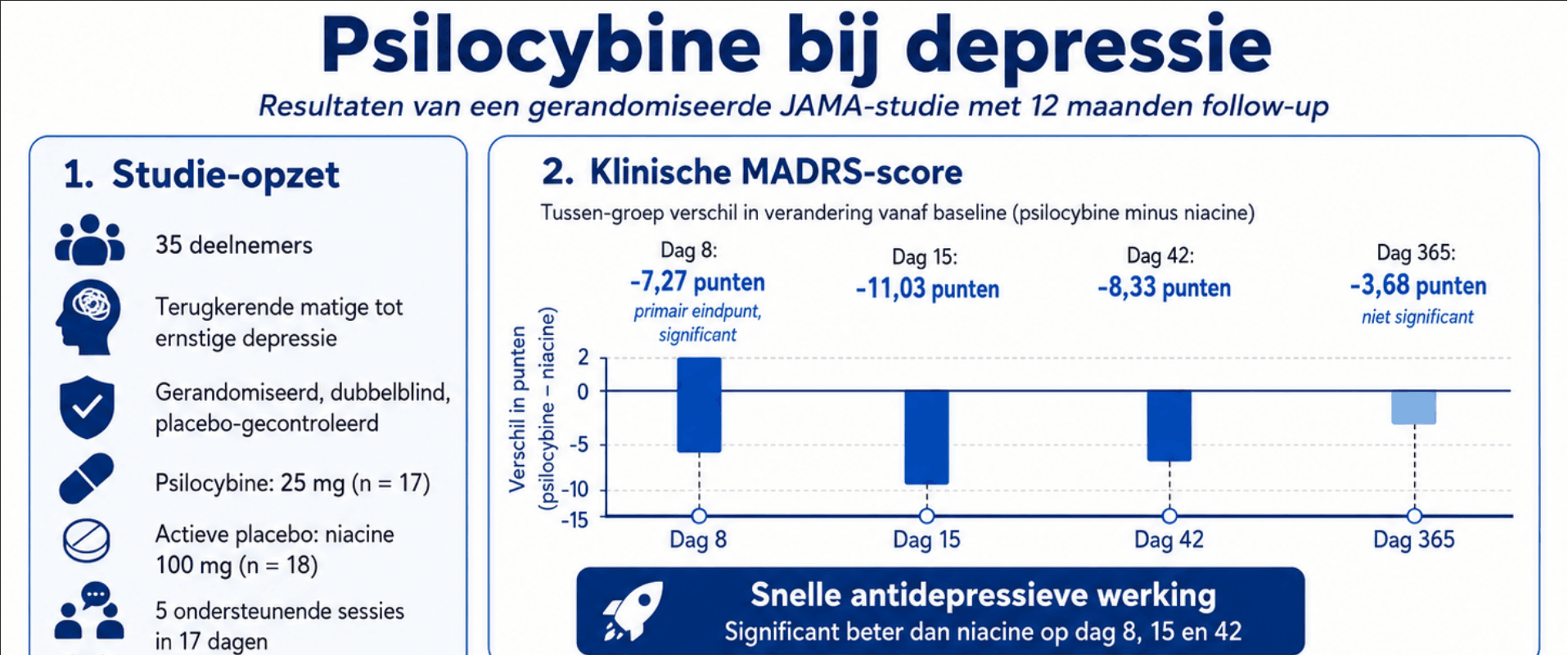
The study was conducted in Sweden, at the Northern Stockholm Psychiatric Clinic and the Karolinska Institutet. A total of 35 participants with recurrent depressive symptoms participated. Seventeen participants received one dose of 25 mg of psilocybin and 18 participants received 100 mg of niacin as an active placebo.
Both groups received psychotherapeutic support around the session. The course consisted of one preparatory session, one dosage day and three integration sessions within a 17-day period. During the session day, participants were encouraged to turn inward, with support from music, eye mask and guidance from psychologists.
The short-term results were clear
The primary outcome measure was the change in depressive symptoms on day 8, measured by the MADRS score. At that primary measurement time, the MADRS score in the psilocybin group decreased by an average of 7.27 points more than in the niacin group. This difference was statistically significant.
Even on day 15 and day 42, the difference between psilocybin and niacin remained significant. On day 15, the mean difference was 11.03 points in favour of psilocybin. On day 42, this difference was 8.33 points. Thus, this study shows mainly a rapid and relatively long-lasting effect in the first six weeks after the session.
Self-reporting showed improvement as early as day 2
In addition to assessment by researchers, participants also filled in questionnaires themselves. On the self-reported MADRS-S score, the difference between psilocybin and niacin was visible as early as day 2. This difference persisted in the main analysis until day 102.
This is interesting because it suggests that participants themselves noticed change very quickly. At the same time, this remains sensitive to expectancy effects, especially in psychedelic research where participants can often guess what substance they were given.
Remission on day 42 was striking
One of the most striking outcomes was the difference in remission at day 42. In the psilocybin group, 52.9% of participants met the criteria for remission, compared with 5.9% in the niacin group. In numbers, this involved 9 out of 17 participants in the psilocybin group and 1 out of 17 assessed in the niacin group.
At day 365, this difference was no longer statistically significant. After one year, remission on the MADRS score was 52.9% in the psilocybin group and 41.2% in the niacin group. This means that psilocybin scored significantly better in the short term, but the long-term difference was less conclusive after one year.
Important nuance: the effect did not stay stronger in everyone for a year
This study is extra valuable because there was a 12-month follow-up. This makes it possible to look not only at the first few weeks, but also at the longer term. The conclusion is nuanced: psilocybin remained better than niacin until day 42 on the clinical MADRS score, and until day 102 on the self-report. After 12 months, the difference between the groups was no longer significant.
The researchers therefore mention that repeated dosing, additional support or a maintenance strategy may possibly be needed to reduce relapse in the longer term. This needs further investigation.
Safety and side effects
Most reported side effects were temporary and mild to moderate. In the psilocybin group, side effects included headache, anxiety, hallucinations, agitation, increased blood pressure and tingling. No serious side effects were reported that were assessed as related to psilocybin.
However, an important safety signal is that two participants in the psilocybin group reported severe and persistent anxiety requiring medical attention. This shows that psilocybin is not light or naturally well tolerated by everyone, even within a controlled research setting with professional supervision.
Blinding remains a problem in psychedelic research
A major limitation of this study is that the blinding did not hold up well. At the end of the study, 94.1% of the participants in the psilocybin group correctly guessed that they had been given psilocybin. In the niacin group, even 100% correctly guessed that they had been given niacin.
Reviewers were also relatively often able to correctly estimate which group someone was in. This is important because expectation, recognition of the psychedelic effect and placebo effects can influence outcomes. The researchers therefore conclude that niacin as an active placebo was insufficient to maintain true blinding.
Who did not participate?
The study also had clear exclusion criteria. People with previous psychedelic use, psychotic or bipolar disorders, a first-degree relative with a psychotic disorder, current substance disorder, pregnancy, ongoing antidepressant treatment, ongoing psychotherapy or suicidality were excluded.
As a result, the results are not simply applicable to everyone with depressive symptoms. In particular, people with more complex problems or acute risks were not included in this study.
Why this research is important
This study is important because it is a randomised, placebo-controlled trial with a relatively long follow-up of 12 months. The results show that one dose of psilocybin with psychotherapeutic support can quickly make a difference on depression scores, especially in the first weeks to months.
At the same time, the study also makes it clear that previous open-label or uncontrolled studies may have overestimated the long-term effect. Without a control group, it is difficult to distinguish between the effect of psilocybin, natural enhancement, expectancy effects, psychological support and other factors.
In one sentence
This JAMA study suggests that one supervised dose of psilocybin for recurrent depressive symptoms works faster than niacin in the first weeks after the session, but that the difference was no longer significant after 12 months and that larger studies remain necessary.
Posted : 19 May 2026 09:39

In previous studies, it also seemed that most positive effects occur the weeks to about 3 months after the session. After that, it depends on the changes a person makes whether one relapses or will improve further. So make full use of the first 90 days after a psilocybin or truffle session!
Posted : 19 May 2026 19:07