
Topic starter
There is a new scientific article appeared about a second experience of group-based psilocybin therapy in people who had been only partially responsive after an initial psilocybin retreat.
The full publication can also be read at Frontiers in Public Health.
In it, we discuss:
The study focused on participants with metastatic cancer who had previously participated in a group retreat with psilocybin therapy but did not experience a full or lasting effect on symptoms such as anxiety, gloom or existential tension. The researchers particularly wanted to know whether a second group psilocybin experience was safe and feasible for this group.
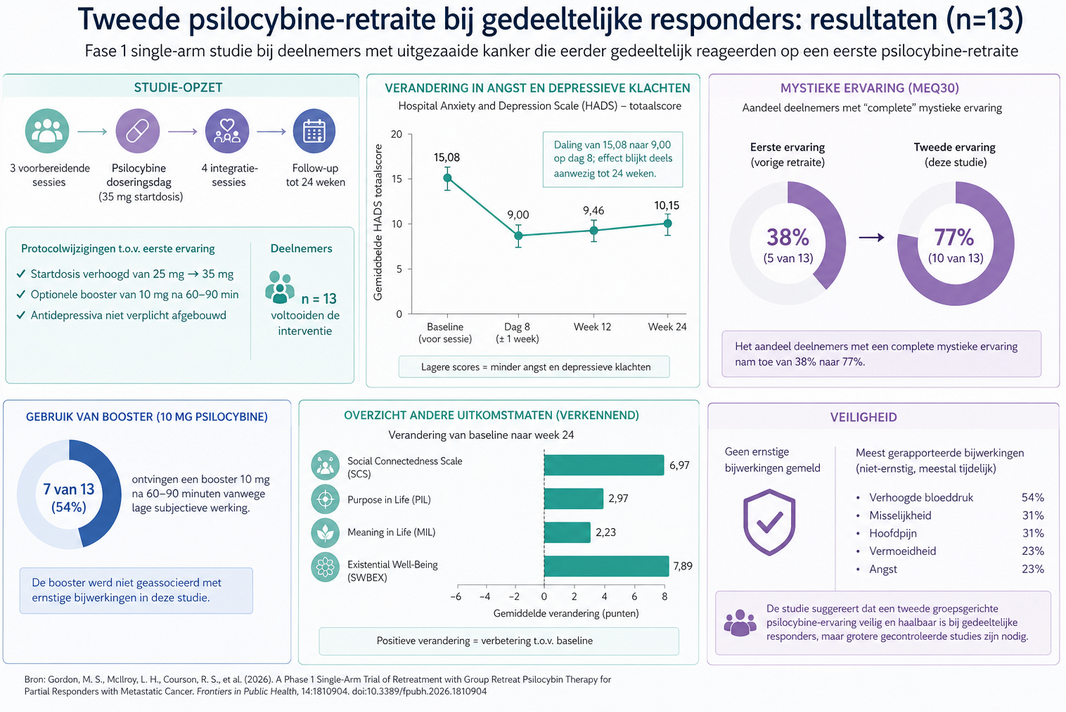
This was a small phase 1 study with no control group. A total of 13 participants completed the intervention. The design consisted of three preparatory sessions, one psilocybin dosing day and then four integration sessions. The second experience was set up slightly differently from the first: the starting dose was increased to 35 mg psilocybin, participants were not required to discontinue antidepressants, and an additional 10-mg booster could be given after 60 to 90 minutes in case of low subjective effect.
According to the authors, no serious side effects occurred. Reported side effects included temporary increase in blood pressure, nausea and headache. Seven of the 13 participants received the additional booster. That booster was also not associated with any new serious safety problems in this small study.
Besides safety, the researchers looked exploratively at psychological outcomes. The mean score on the Hospital Anxiety and Depression Scale fell from 15.08 at baseline to 9.00 around day 8, and the improvement remained partially visible until 24 weeks after the session. Also, the proportion of participants with a so-called “complete” mystical experience increased from 38% during the first experience to 77% during the second experience.
A key component of this study is the group model. The authors place this in the context of public health: individual psychedelic therapy with two therapists per person is intensive and costly, while group models may be more scalable. The study suggests that group-based preparation, counselling and integration can play an important role in accessibility and social support.
Importantly, however, this study does not provide evidence that a second psilocybin retreat works better for everyone. The study had no control group, the number of participants was small, the group was highly selected and all participants had previous experience of a previous psilocybin study. Multiple protocol changes were also implemented at the same time, so it is not clear which component was responsible for the reported improvements.
In one sentence, this small phase 1 study suggests that a second group-based psilocybin experience in partial responders with metastatic cancer may be safe and feasible, but larger controlled studies are needed before firm conclusions can be drawn. Also, group ceremonies with less psyhotherapeutic support may be as effective as psychedelic therapy with lots of psychotherapy, but more research is also needed to establish this.
Spoiler
New article description
Abstract in brief
This phase 1 study investigated a second experience of Group Retreat Psilocybin Therapy in participants with metastatic cancer who had been only partially responsive after a previous psilocybin retreat. The intervention consisted of preparatory sessions, a psilocybin dosing day and several integration sessions. The researchers increased the starting dose to 35 mg, allowed an optional booster of 10 mg and did not require participants to taper off antidepressants beforehand. Thirteen participants completed the intervention. No serious side effects were reported; the most common side effects were temporary increase in blood pressure, nausea and headache. In addition, the authors saw exploratory improvements in anxiety and depression scores, social connectedness and intensity of mystical experience. Due to the small number of participants and the lack of a control group, the results should be interpreted with caution.
Keywords: psilocybin therapy; group retreat psilocybin therapy; metastatic cancer; cancer-related anxiety; depression; existential distress; retreat; integration; group therapy; psychedelic public health.
Posted : 30 April 2026 14:50