30 September 2024 13:52
Topic starter
1

Does ayahuasca, just like psilocybin, also cause neuroplasticity? Which of these substances results in the highest rate of neurogenesis?
2 Answers
3
9 April 2025 12:30

Ayahuasca with DMT also promotes neuroplasticity, similar to psilocybin. Both substances influence serotonin receptors in the brain, leading to changes in neurochemistry and the stimulation of neurotrophins such as BDNF (Brain-Derived Neurotrophic Factor). BDNF plays a crucial role in the growth, development, and survival of neurons and is essential for neuroplasticity.
Research has shown that both ayahuasca and psilocybin can increase neuroplasticity by stimulating the release of BDNF. This can lead to the formation of new neural connections and the repair of damaged brain cells. Studies have suggested that the effects of ayahuasca on neuroplasticity may also be related to the interaction of DMT with serotonin receptors, leading to increased synaptic plasticity.
Regarding the degree of neurogenesis, there are indications that psilocybin may offer a stronger stimulus for neurogenesis compared to ayahuasca. Research has shown that psilocybin can promote the production of new neurons in the hippocampus, an area of the brain crucial for learning and memory. This effect is often attributed to the increased BDNF levels caused by psilocybin.
Although insufficient comparative research has been conducted to draw definitive conclusions regarding which substance induces the highest rate of neurogenesis, based on current scientific literature, psilocybin appears to play a significant role in promoting neurogenesis and neuroplasticity.
More info:
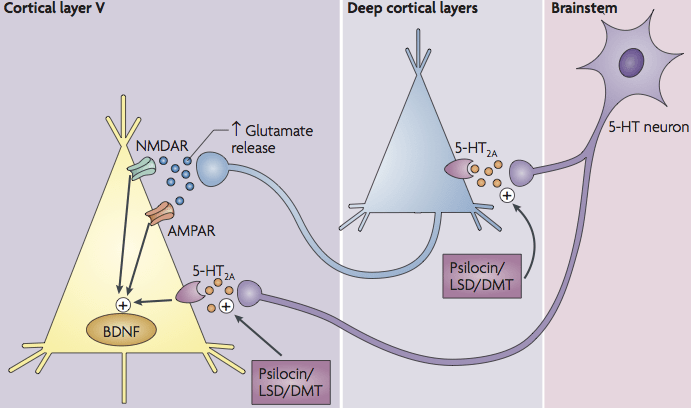
1
9 April 2025 12:49

Psychedelics such as LSD, psilocybin, and ayahuasca stimulate neuroplasticity via neurotrophin signals. In particular, BDNF (brain-derived neurotrophic factor) and its receptor TrkB play a crucial role. LSD and psilocybin (via psilocin) They bind very strongly to TrkB—up to a thousand times stronger than classic antidepressants—and thereby activate BDNF signaling pathways independently of 5‑HT₂A. In mouse and culture studies, for example, LSD increased BDNF mRNA within 1 hour and BDNF protein after 24 hours, and LSD showed a ~2× increase in BDNF protein in cultured neurons. Low-dose LSD (5–20 μg) also acutely increased plasma BDNF in healthy volunteers. Psilocybin (30 mg) shows a similar TrkB effect: psilocin binds TrkB just like LSD and promotes dendritic spin formation. In mice, a low dose of psilocybin resulted in a slightly increasing tendency in hippocampal neurogenesis (a high dose actually decreased it).
Ayahuasca (DMT plus MAO inhibitors such as harmine) also increases BDNF, but likely indirectly. An RCT found that 48 hours after a single dose of ayahuasca, serum BDNF was increased by ~15% compared to placebo. Chronic administration (28 days) also led to higher hippocampal BDNF in rats (especially at high doses in female animals). Harmine, a β-carboline in ayahuasca, increases BDNF in the hippocampus on its own. Unlike LSD/psilocybin, there is no evidence that DMT binds directly to TrkB. DMT can promote plasticity via the sigma-1 receptor (e.g., powerful stimulation of neurogenesis in the hippocampus), but this does not occur primarily via BDNF/TrkB.
TrkB antagonists block the neuroplastic effects of all psychedelics. In cultured neurons, the selective TrkB inhibitor ANA-12 completely switched off LSD-, DMT-, or DOI-induced neuritogenesis and spinogenesis. This confirms that the BDNF/TrkB signal is essential for the plasticity effect. In summary, enhance LSD and psilocybin their plasticity promotion primarily via direct TrkB activation and BDNF signaling. Ayahuasca/DMT increases BDNF and plasticity largely via side mechanisms (hormetic effects of β-carbolines and sigma‑1 interaction).
In terms of neurogenesis DMT/ayahuasca scores higher: mice show a strong increase in hippocampal neurogenesis after DMT treatment. LSD appears to have no effect on adult neurogenesis in rodents; psilocybin shows a slightly positive tendency only at low doses (high doses reduce neurogenesis).
All in all, the literature suggests that LSD the strongest TrkB activation and BDNF upregulation gives, followed by psilocybin, while ayahuasca causes a more moderate increase in BDNF via additional components. Below is an overview table of the most important markers.
| Resourse | BDNF production | TrkB activation | Other neurotrophins | Neurogenesis |
|---|---|---|---|---|
| LSD | ↑ Bdnf mRNA (1 h) and BDNF protein (24 h); microdose ↑ plasma BDNF | Direct, high-affinity binding to TrkB; promotes TrkB dimerization and downstream signals | No data; effect on other neurotrophins not investigated | No increase in adult neurogenesis (rats) |
| Psilocybin (PSI) | TrkB binding implies BDNF increase (LSD analogy); in mouse hippocampal status, slight increase at low dose | Direct TrkB binding, similar to LSD; increased spine density in vitro | Unknown; no specific data (potential NGF/NT-3 effects not measured) | Low dose: slight increase in DG neurogenesis; high dose: decrease |
| Ayahuasca (DMT+MAOI) | ↑ serum BDNF ~15% after 48 hours in humans; ↑ hippoc. BDNF with long-term use (rat) | No reported TrkB binding. Increases plasticity via sigma-1 and secondary factors (hormin). | Hormin components ↑ BDNF; effect on NGF/NT-3 not studied | Strong increase in hippoc. neurogenesis (DMT stimulates subgranular zone) |
Sources: Primary research with mice and humans: animal studies show LSD/psilocybin direct TrkB activation and plasticity; human data show increases in BDNF after ayahuasca and micro-LSD. In vitro, all psychoplastogens also appear to act as plasticity agents via BDNF/TrkB. The table shows relative effects; at the cellular level, LSD leads to the greatest BDNF and TrkB activation, followed by psilocybin and ayahuasca (DMT).
Conclusion:
Neuroplasticity:
Yes, ayahuasca, just like psilocybin, promotes neuroplasticity. Both substances increase BDNF levels, which plays an important role in neuroplasticity. Psilocybin stimulates neuroplasticity primarily through direct activation of the TrkB receptor via BDNF, while ayahuasca achieves this effect largely indirectly via DMT (sigma-1 receptor) and β-carbolines (harmine).
Neurogenesis:
Ayahuasca (DMT) causes the highest rate of neurogenesis. Animal studies clearly demonstrate that DMT strongly stimulates neurogenesis in the hippocampus, whereas psilocybin has only mild to moderate effects in this brain region, depending on the dosage. LSD shows no significant effects on adult neurogenesis.
In summary:
Neuroplasticity: Psilocybin > Ayahuasca
Neurogenesis: Ayahuasca (DMT) > Psilocybin > LSD
Neuroplasticity and neurogenesis are related, but not the same:
Neuroplasticity refers to the ability of existing neurons to change, strengthen, or weaken connections. This occurs through dendrite formation, synapse formation, and adjustment of synapse strength. Neuroplasticity is therefore primarily the restructuring of existing networks.
Neurogenesis refers specifically to the creation of new neurons from stem cells, especially in specific brain regions such as the hippocampus. This therefore involves adding new cells to existing networks.
Other areas:
If we look at brain regions other than the hippocampus, the difference between neuroplasticity and neurogenesis becomes even clearer:
Outside the hippocampus, the following applies:
-
Neuroplasticity:
-
It is widely distributed, in virtually all brain regions.
-
Psychedelics such as LSD, psilocybin, and ayahuasca demonstrably stimulate plasticity in, for example:
-
Prefrontal cortex (emotional regulation, decision-making)
-
Amygdala (emotional processing, fear conditioning)
-
Cortex areas which are involved in perception, consciousness, and cognition.
-
-
LSD and psilocybin, in particular, have been extensively studied and show strong effects on dendrites and synapse formation in cortical neurons. Ayahuasca has similar effects, but is slightly less strongly documented for cortical areas (most research focuses on the hippocampus and limbic system).
-
-
Neurogenesis:
-
Outside the hippocampus, adult neurogenesis is limited or almost absent, with the exception of specific niches such as the subventricular zone (SVZ).
-
There is virtually no reliable evidence that LSD, psilocybin, or ayahuasca substantially influence neurogenesis outside the hippocampus in adult animals or humans.
-
DMT (in ayahuasca) powerfully stimulates neurogenesis specifically in the hippocampus (especially the subgranular zone of the dentate gyrus), but there is no strong evidence that this effect occurs elsewhere.
-
In summary (outside hippocampus):
| Brain area | Neuroplasticity | Neurogenesis |
|---|---|---|
| Prefrontal cortex | ✅ Yes (LSD, psilocybin, ayahuasca) | ❌ No significant evidence |
| Amygdala | ✅ Yes (LSD, psilocybin, ayahuasca) | ❌ No significant evidence |
| Cortical areas | ✅ Yes (especially LSD, psilocybin) | ❌ No significant evidence |
| Subventricular zone (SVZ) | 🟡 Insufficient research | 🟡 Possible, but limited evidence |
The marked increase in neurogenesis caused by ayahuasca is primarily limited to the hippocampus. Neuroplasticity, on the other hand, is a general phenomenon that occurs to a much broader extent in multiple brain regions and is strongly present with psilocybin, ayahuasca, and LSD.