
Topic starter
There is a new scientific article in *Cell Reports Medicine* published on neuroplastic changes in white matter in patients with depression following treatment with LSD.
The following was found in it:
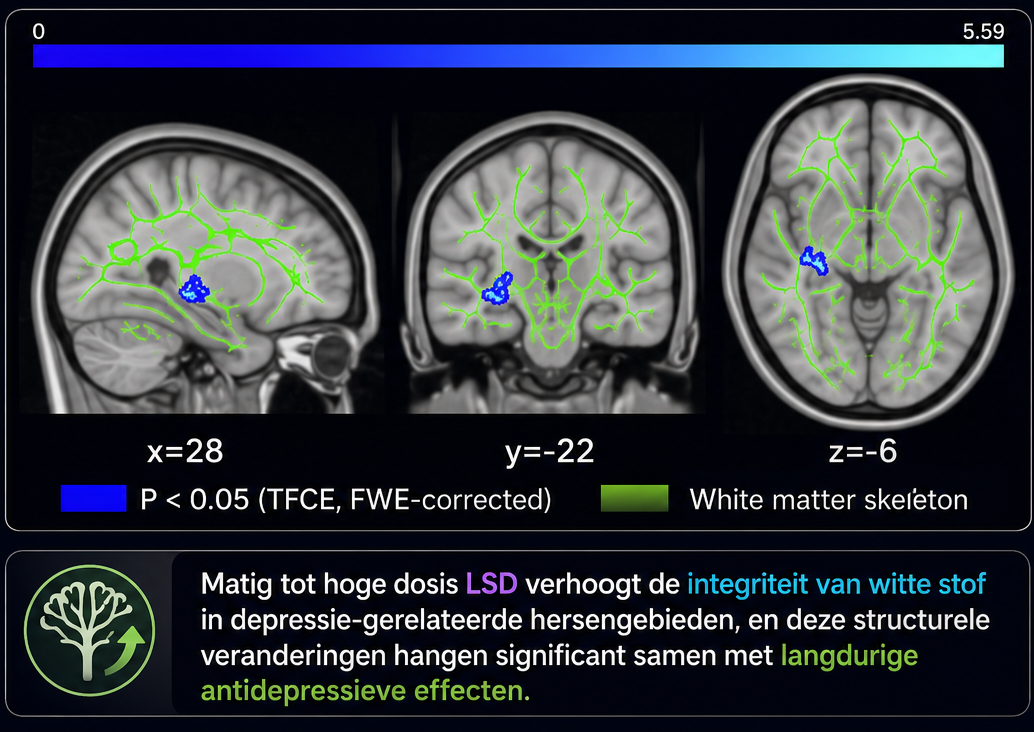
Moderate to high doses of LSD increase the integrity of white matter in areas of the brain affected by depression, and these structural changes are significantly associated with long-term antidepressant effects.
In other words: LSD not only appears to improve mood, but may do so partly through a measurable strengthening of the white-matter pathways involved in emotion regulation.
The research
The researchers wanted to find out whether LSD alters the microstructure of white matter in people with major depressive disorder (MDD), as a possible underlying mechanism of its antidepressant effect. Psychedelics are known for their ability to promote neuroplasticity, but in vivo evidence in humans has so far been limited.
Sixty-one patients with MDD took part in this randomised study. They were assigned to either a low-dose group (LD-LSD: 2 × 25 μg) or a moderate-to-high-dose group (HD-LSD: 100 μg, followed by 200 μg). In 35 of these patients (17 in the HD-LSD group), diffusion tensor imaging (DTI) was performed before and after the intervention to measure white matter integrity using fractional anisotropy (FA).
It is important to emphasise that the study focused on structural changes in the brain, not on the subjective experience of the trip. The key question was whether a difference in white-matter microstructure could be measured between the two dosage groups, and whether any changes were associated with the progression of depressive symptoms over the following weeks.
The results showed that the HD-LSD group exhibited a significant increase in fractional anisotropy in the internal and external capsules, the sagittal stratum and the fornix/stria terminalis. This effect was absent in the LD-LSD group. The increase was of large effect size (Cohen’s d = 1.48). Almost all patients in the HD group showed an individual increase in FA, whilst the low-dose group showed variable or negligible changes.
This increase in FA correlated significantly with the reduction in depressive symptoms at 2, 6 and 12 weeks following treatment, as measured by the Inventory of Depressive Symptomatology (IDS-C and IDS-SR). The relationship remained robust after adjusting for the baseline depression score. Notably, subjective experiences such as oceanic boundlessness and mystical experiences did not correlate with the FA changes. In a regression analysis, however, the subjective effects predicted symptom improvement more strongly than the white matter changes.
The authors note that this is the first time that in vivo neuroplastic changes in white matter have been demonstrated in people with depression following LSD treatment. The changes affect precisely those pathways that meta-analyses consistently describe as being reduced in MDD, including the capsular and limbic connections. At the same time, they point out that it cannot be definitively established whether the increase in FA is directly caused by LSD, or is partly a consequence of the resolution of the depression.
In terms of safety, the treatments were well tolerated. The study formed part of a larger clinical trial (NCT03866252) in which the dosages and protocol had already been evaluated. No unexpected serious adverse events occurred that could explain the imaging results.
The authors conclude that LSD-induced changes in white matter microstructure are associated with antidepressant effects in MDD. They emphasise that further neuroimaging research is needed to clarify the directional relationship, duration and replicability of these findings in broader populations.
Spoiler
New article description
Abstract in brief
This study investigated whether LSD alters the microstructure of white matter in patients with major depressive disorder (MDD), as a potential neuroplastic mechanism underlying its antidepressant effect. In a sub-analysis of the randomised trial NCT03866252, 61 patients received either a low dose (2 × 25 μg) or a moderate-to-high dose (100 μg, followed by 200 μg) of LSD. DTI scans taken before and after the intervention in 35 patients showed that the HD-LSD group exhibited a significant increase in fractional anisotropy (FA) in the internal and external capsules, the sagittal striatum and the fornix/stria terminalis (Cohen’s d = 1.48), whilst the LD-LSD group showed no clear effect. The increase in FA correlated significantly with symptom relief at 2, 6 and 12 weeks. Subjective experiences did not correlate with the FA changes. The authors conclude that LSD-induced changes in white matter microstructure are associated with antidepressant effects in MDD, and that these findings provide insight into possible structural mechanisms underlying psychedelic therapy.
Keywords: LSD; lysergic acid diethylamide; major depressive disorder; white matter; neuroplasticity; diffusion tensor imaging; fractional anisotropy; DTI; psychedelics; antidepressant; Cell Reports Medicine; NCT03866252; internal capsule; sagittal stratum; fornix.
Our view on this study
Our view of this research is that it makes an important contribution to our understanding of how psychedelics might work at a structural level. Until now, the debate has often focused on subjective experiences, mystical effects and acute psychological insights; this study shows that there are also objective, measurable changes in brain structure associated with long-term improvement.
As with previous research into psilocybin and ketamine, we are seeing a shift here from merely providing acute symptom relief to exploring how these effects can be sustainably embedded in the brain. Whilst ketamine research often focuses on synaptogenesis and cortical SV2A density, and psilocybin studies on default mode network connectivity, this LSD research highlights white matter integrity as a new biological pillar. It reinforces the hypothesis that psychedelics not only cause the brain to function differently for a short time, but may also structurally repair damage caused by depression.
This study therefore forms part of a broader trend: away from the strict separation between psychology and biology, towards an integrated model in which neuroplasticity forms the bridge between the treatment experience and long-term clinical outcomes. For clinical practice, this could eventually mean that dosage and treatment protocols are tailored not only to the intensity of the experience, but also to the extent to which they stimulate white matter tracts.
At the same time, caution is still advised. The sample size for the neuroimaging study is small (35 patients, 17 in the HD group), and the study cannot distinguish whether the increase in FA is a direct pharmacological effect of LSD or a secondary consequence of the resolution of depression. Furthermore, the subjective effects were a stronger statistical predictor of symptom relief than the white-matter changes, suggesting that structure and experience make parallel, partly independent contributions.
In one sentence: this article shows that moderate-to-high doses of LSD induce measurable changes in white-matter integrity in people with depression, in areas affected by the condition, and that these changes are associated with long-term symptom relief; however, this is still an early, step that must be interpreted with caution in mapping the neurobiological mechanisms underlying psychedelic therapy.
Posted : 18 June 2026 22:13