
Topic starter
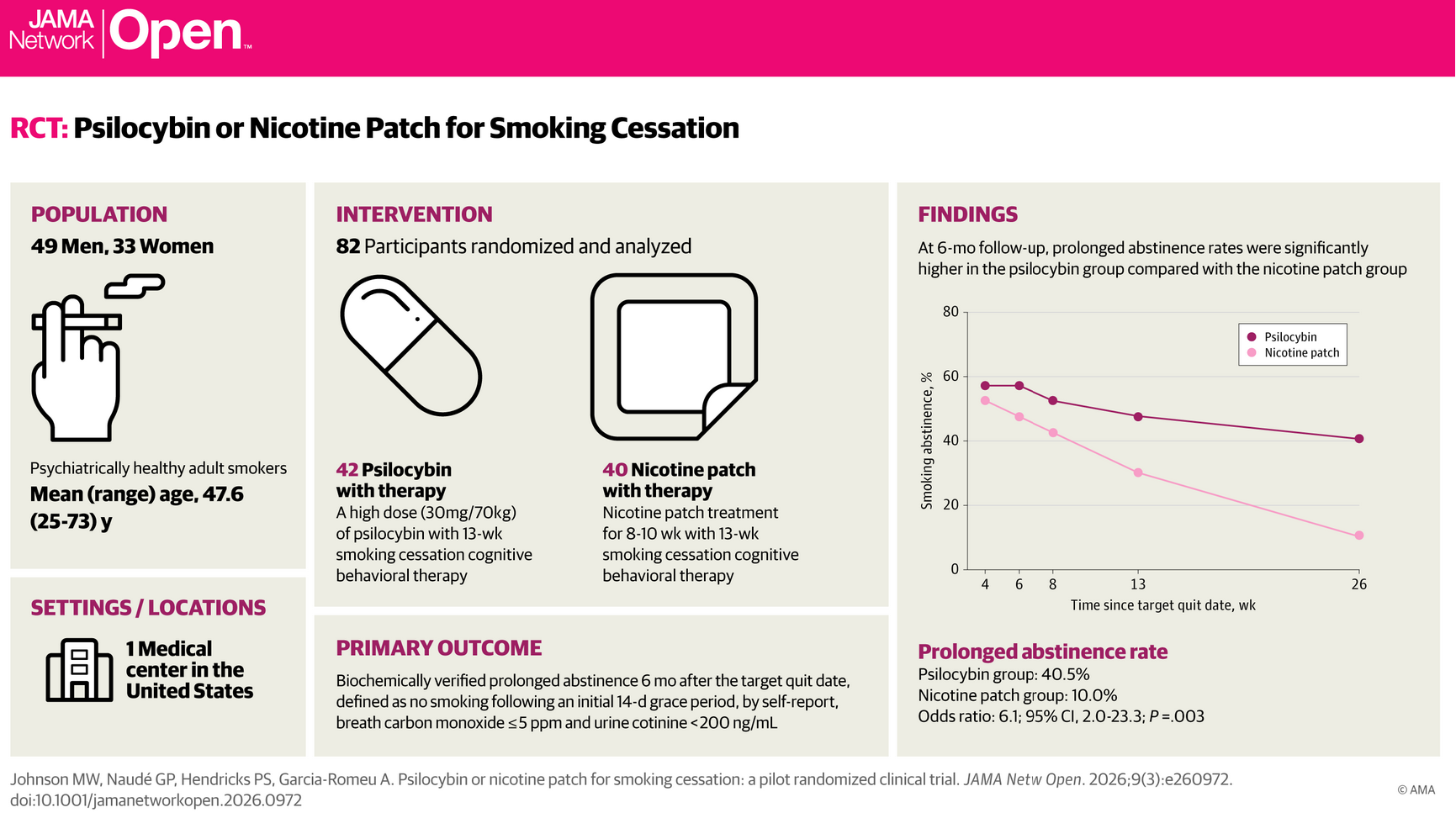
More than four times as many people quit smoking after a single dose of psilocybin, compared to treatment with nicotine patches. This is shown in a study published in March 2026 in JAMA Network Open, carried out by researchers from Johns Hopkins University under the leadership of Matthew W. Johnson. The study is significant because it is the first randomized experiment in which psilocybin is directly compared to an established treatment for nicotine addiction.
Get the investigation out?
The researchers divided 82 adult smokers into two groups. All participants followed the same cognitive behavioral therapy (CBT) program for thirteen weeks, aimed at quitting smoking. The difference between the groups lay solely in the treatment on the quit date.
One group received a single high dose of psilocybin of 30 mg per 70 kilograms of body weight. The other group started standard treatment with nicotine patches at that time, which was used for eight to ten weeks.
The participants were not light smokers. They smoked an average of about 16 cigarettes per day and had already made about six previous attempts to quit. The average age was around 48 years, and all participants had been psychiatrically screened prior to participation.
Six months after the stop date, it was measured how many participants had actually stopped. This was done not only through self-reporting, but also with urine tests and CO measurements of exhaled air, so that the results could be biologically confirmed.
The results
The results were clear. After six months, 40.5 percent of the participants in the psilocybin group had demonstrably stopped smoking. In the nicotine patch group, this was approximately 10 percent.
This means that more than four times as many people had quit in the psilocybin group. Furthermore, the statistical analysis showed that the chance of long-term abstinence was approximately six times greater than with the nicotine patch.
Psilocybin also scored better when a second measure was considered, namely whether someone had not smoked in the seven days prior to the measurement. In that analysis, approximately 52 percent of the psilocybin group did not smoke, compared to approximately 25 percent in the patch group.
In addition, it was found that participants in the psilocybin group who still smoked consumed fewer cigarettes per day on average than participants in the patch group. This suggests that the treatment may help not only with quitting completely, but also with reducing the number of cigarettes.
Why might psilocybin work?
The exact reason why psilocybin can help with addiction is not yet fully clear. However, there are several hypotheses.
Psilocybin acts via serotonin receptors in the brain, particularly the 5-HT2A receptor, among others. During a psychedelic experience, the way brain networks process information changes temporarily. As a result, patterns of thinking and behavior can become less entrenched.
Addiction consists largely of automatic habits. Many smokers, for example, reach for a cigarette when stressed, after a meal, or while drinking coffee. Due to the way psilocybin influences information processing in the brain, it may potentially help to temporarily break those automatic patterns.
Moreover, many participants describe viewing their own behavior and habits differently during a psychedelic session. It can feel as if one is looking at one's own life with more distance, which can strengthen motivation for change. The combination with behavioral therapy subsequently seems to help translate these insights into concrete behavior.
An interesting detail from the study is that it made no difference whether participants had had previous psychedelic experiences. People without prior experience benefited just as much as people who were already familiar with psychedelics.
One session versus weeks of treatment
When you compare the two treatments, the difference in approach stands out.
The psilocybin group received a single, guided session that lasted approximately one day. The nicotine patch group, on the other hand, used a patch daily for eight to ten weeks.
This shows that we are dealing with two completely different treatment models. Psychedelic therapy concentrates the treatment into one intensive experience, while classical pharmacotherapy is based on long-term daily medication.
What can you conclude from this?
The researchers emphasize that the study is relatively small. With 82 participants, it is a pilot study. Additionally, the participants were relatively homogeneous, for example in terms of education and psychiatric health.
Furthermore, the study was not blinded. Participants therefore knew which treatment they were receiving, which can influence expectations.
Nevertheless, the study is important because it makes a direct comparison between psilocybin and an existing treatment for nicotine addiction for the first time. Moreover, the results align with previous studies in which psilocybin already showed promising effects for quitting smoking.
In addition, scientific research into psychedelics for other addictions, such as alcohol and opioid addiction, is growing. This suggests that psychedelic therapy may potentially play a broader role in breaking addiction patterns.
Even better results with supplements
In addition to the psilocybin session itself, additional support through lifestyle and certain supplements can potentially further enhance the results. In practice, with Triptherapie, for example, attention is paid to the use of GABA and DHEA. GABA is an inhibitory neurotransmitter that can contribute to greater relaxation, less inner turmoil, and better emotional regulation during the preparation process. DHEA is a hormone involved in, among other things, stress regulation, resilience, and the body's recovery capacity. When these systems are better balanced, it can support the process of introspection, emotional processing, and behavioral change.
In addition to supplements, lifestyle optimization an important role. Consider sufficient sleep, a healthy diet, exercise, and reducing alcohol or other substances prior to a session. By improving these factors, the body and brain can become more receptive to the therapeutic insights that arise during a psychedelic experience. In practice, we see that a combination of good preparation, lifestyle coaching, and targeted supplementation can sometimes further enhance the positive effects of a session.
See also: GABA, DHEA, and psilocybin in addiction
Finally
Many people only succeed in quitting smoking after multiple attempts. The participants in this study had already tried six times before, on average. The fact that significantly more people appeared to have quit six months after just one guided psilocybin session, combined with behavioral therapy, makes this study particularly interesting.
Whether psilocybin will become a standard treatment for nicotine addiction in the future will depend on larger clinical studies, regulation, and societal acceptance. However, the research shows that psychedelic therapy is a serious candidate for new treatment strategies for addiction.
At Triptherapie In any case, it is already possible to receive guidance with psilocybin (truffles), including an additional approach to addiction. We are the leader in this field in the Netherlands, with 3,500+ clients and various therapists and lifestyle coaches.
Posted : 15 March 2026 19:47