
Topic starter
Study in brief
This article is: “Comparing single- and repeat-dose psilocybin with active placebo for migraine prevention in an exploratory randomized controlled clinical trial”, by Schindler and colleagues, published online on December 29, 2025 in Headache.
What they have investigated
The researchers wanted to know whether psilocybin could help prevent migraines, and whether a single dose or a repeated dose after 7 days worked better. It was a randomized, double-blind, placebo-controlled parallel-group study in adults with migraine who had an average of at least two migraine days per week at baseline. A total of 18 participants took part. Over two sessions, they received either diphenhydramine alone as the active placebo, or psilocybin once and diphenhydramine once, or psilocybin twice. The psilocybin dose was 10 mg per session and the active placebo was 25 mg diphenhydramine. The primary outcome was the change in migraine frequency based on a headache diary from 2 weeks before to 8 weeks after the second session.
Key findings
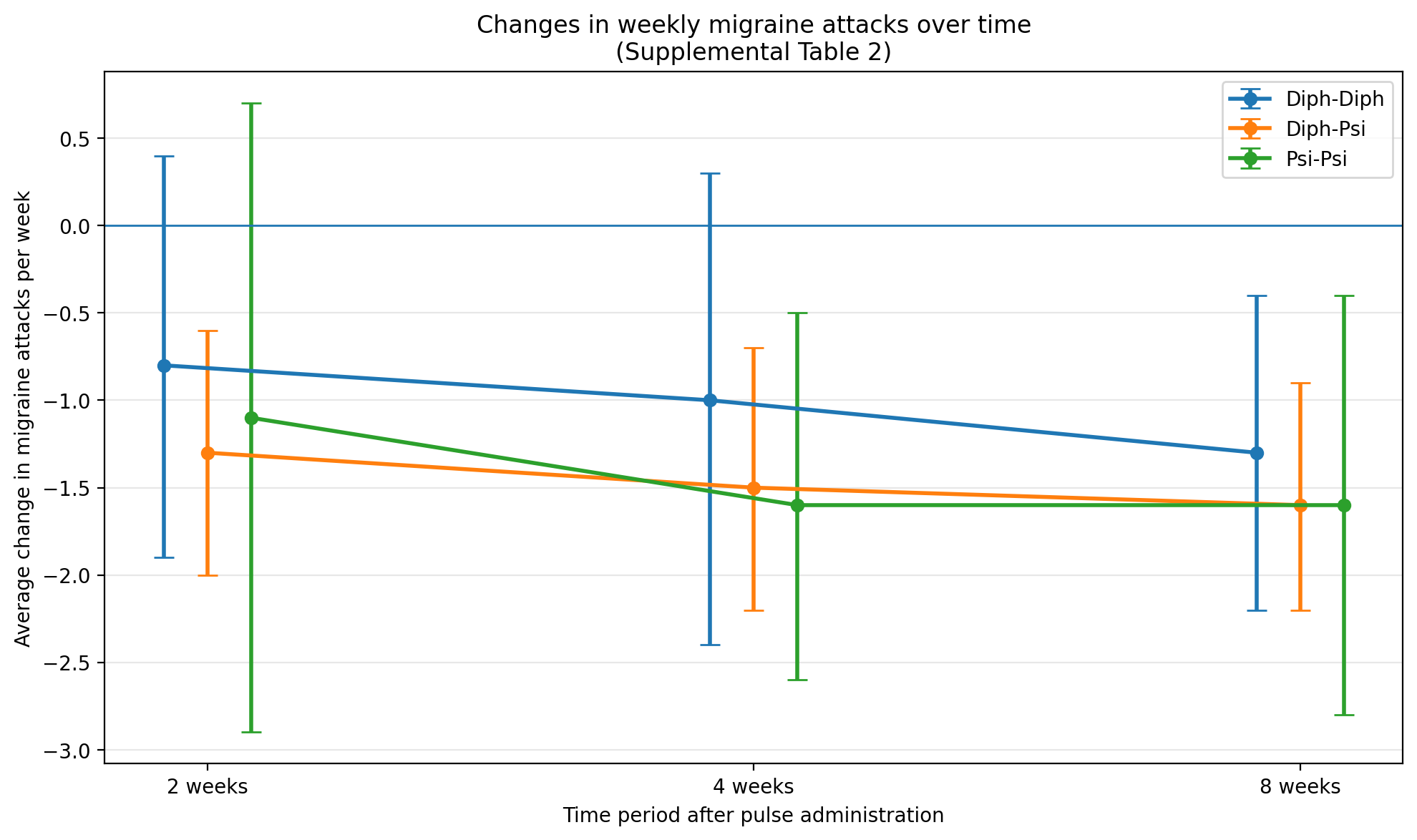
In the first 2 weeks after completion of the two sessions, the difference between the three groups for the decrease in migraine days per week was not statistically significant: diph-diph -0.7, diph-psi -2.0, psi-psi -1.7; p = 0.102. At the same time, the authors did observe large effect sizes compared to placebo, particularly in the group that received a single dose of psilocybin. Over the entire 8-week measurement period, migraine frequency decreased in all groups by approximately 50%. The 50% responder rate over 2 weeks was 17% for placebo only and 80% for both psilocybin groups, but this also just failed to reach statistical significance, with p = 0.087.
How best to read this
The core issue, therefore, is not that this study already convincingly proves that psilocybin works against migraine at a low dose of 10mg. The study primarily shows that there is an interesting signal, but not yet hard evidence of superiority over placebo. It is also striking that one dose appeared numerically better than two doses, which does not fit well with the idea that more or more frequent use would automatically be better. However, due to the small number of participants, this could simply be a coincidence. Furthermore, the low dose of 10mg is not optimal for accurately measuring the effect of psilocybin. In our opinion, 25-45mg is a better choice.
Placebo and blinding are especially important here.
The study used diphenhydramine as the active placebo to make the blinding more credible. The researchers conclude that this agent partially mimicked the acute effects of psilocybin, but not completely. This is important because participants might still have been able to guess what they had received. Furthermore, the authors found no correlation between migraine improvement after psilocybin and drug confidence, general acute drug effects, or acute psychedelic effects. No serious or unexpected side effects occurred.
What does this say?
The data suggest that psilocybin may play a role as a transitional preventive treatment for migraine, but this trial is too small to draw firm conclusions yet. The study is particularly valuable because it demonstrates the challenges of migraine research with psychedelics, especially due to placebo effects, expectation bias, and the problem of incomplete blinding. The authors themselves state that future studies must be designed very carefully to better distinguish between drug and non-drug effects. Another hypothesis is that migraine may be partly a psychosomatic symptom or that treatments with a major impact on the psyche, such as psychedelic therapy, could help via the placebo route.
Practical conclusion in one sentence
This study is encouraging, but does not yet convincingly demonstrate that a low dose of psilocybin works better than an active placebo for migraine prevention. Subsequent studies must determine whether higher doses of psilocybin in combination with lifestyle modifications work better.
Posted : 2 April 2026 15:40