
Topic starter
There is a new research article in *Translational Psychiatry* have been published on possible epigenetic changes following psilocybin use in people with alcohol use disorder.
The following was found in it:
Sevidence that psilocybin is associated with changes in DNA methylation around genes that may be linked to serotonin signalling, immune function and neuroplasticity, as well as improvements in depressive symptoms and feelings of hopelessness. What they did not find: convincing evidence that psilocybin significantly improved the primary alcohol-related outcomes in this small study.
The research
The researchers investigated whether psilocybin is associated with changes in DNA methylation. DNA methylation is an epigenetic process whereby gene activity can be influenced without the DNA code itself changing. This study analysed blood samples from people who had previously taken part in a randomised, double-blind, placebo-controlled trial of psilocybin for alcohol use disorder.
The study involved 37 participants who had stopped drinking alcohol prior to taking part. The participants were given either 25 mg of psilocybin or a placebo containing mannitol. There were three assessment points: at baseline, 24 hours after dosing and approximately one month after dosing. The researchers combined blood tests for DNA methylation with psychological questionnaires and data on alcohol consumption.
It is important to note that the original clinical trial found no significant effect on the primary outcomes: there was no significant difference between the psilocybin group and the placebo group in terms of the duration of abstinence and average alcohol consumption. However, greater improvements were observed in the psilocybin group on secondary measures, including depressive symptoms and hopelessness. This makes the study particularly interesting as a mechanistic and exploratory study, rather than as evidence that psilocybin treats alcohol problems.
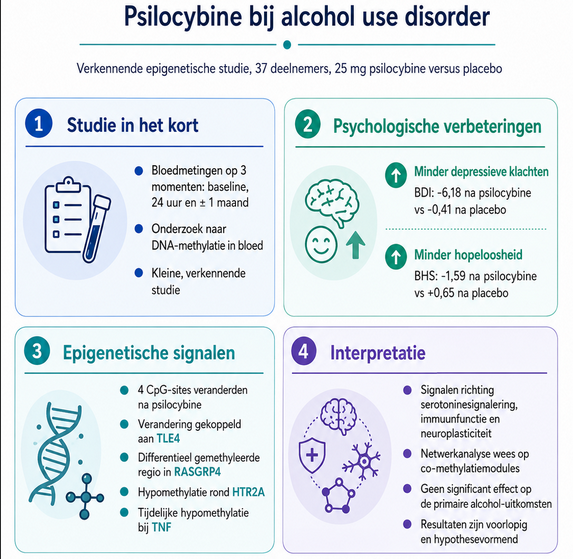
The epigenome-wide association study, or EWAS for short, identified one CpG site associated with psilocybin treatment, which was linked to the TLE4 gene. In addition, the researchers observed a differentially methylated region in the RASGRP4 gene. Both findings are of interest because these genes may be linked to processes such as gene regulation, immune function and, possibly, neuroplasticity; however, the significance of these findings should be interpreted with caution.
A supplementary network analysis revealed co-methylation modules associated with psilocybin treatment, a reduction in depressive symptoms and drinking behaviour. The gene functions identified in this context related, amongst other things, to neuroplasticity, immune function, synaptic transmission and cell regulation. The researchers emphasise that some of these patterns may also be linked to abstinence or recovery processes, and therefore cannot automatically be attributed to psilocybin itself.
In a targeted analysis of candidate genes, the researchers identified nominal methylation changes in the promoter regions of HTR2A and TNF. HTR2A is relevant because the 5-HT2A receptor is a key target for classical psychedelics. TNF is of interest due to its potential link with immune signalling. However, not all of these candidate findings held up following more rigorous corrections, meaning they should primarily be viewed as starting points for further research.
An important point is that this study uses blood samples rather than brain tissue. Consequently, it remains difficult to say definitively what these methylation patterns mean for processes in the brain. Furthermore, the study group was small, which limited the statistical power. The authors therefore rightly state that the results are hypothesis-generating and must first be replicated in larger studies.
The value of this article lies primarily in the fact that, according to the authors, this is the first methylome-wide analysis of psilocybin-induced methylation changes in a clinical population. The research provides potential insights into how psilocybin might influence biological processes relating to serotonin signalling, immune function and recovery following alcohol consumption, but it does not yet yield a reliable biomarker or a proven mechanism of action.
In a nutshell: this article shows that psilocybin in people with alcohol use disorder may be associated with small, exploratory changes in DNA methylation, particularly around genes that may be involved in serotonin and immune processes, but the findings are preliminary and need to be confirmed in larger studies.
Spoiler
New article description
Abstract in brief
This exploratory study investigated psilocybin-induced changes in DNA methylation in people with alcohol use disorder. The researchers analysed blood samples from 37 participants at three time points: baseline, 24 hours after receiving 25 mg of psilocybin or a placebo, and approximately one month later. The original clinical trial found no significant effect on the primary outcomes relating to abstinence and alcohol consumption, but did find differences in secondary measures such as depressive symptoms and hopelessness. The EWAS analysis identified one CpG site in TLE4 associated with psilocybin treatment and a differentially methylated region in RASGRP4. Network analyses identified modules associated with psilocybin, depressive symptoms and drinking behaviour, with possible involvement of neuroplasticity and immune function. Nominal changes were observed in the candidate genes HTR2A and TNF. Due to the small sample size, the use of blood rather than brain tissue, and the exploratory nature of the study, the results should be interpreted with caution.
Keywords: psilocybin; alcohol use disorder; DNA methylation; epigenetics; methylome; EWAS; TLE4; RASGRP4; HTR2A; TNF; serotonin signalling; immune signalling; neuroplasticity; alcohol relapse; abstinence; depressive symptoms; Translational Psychiatry.
Our view on this study
Our view of this research is that this epigenetic study is consistent with previous research in which psilocybin was linked to changes in inflammatory markers. Previous research has described changes in TNF-α, IL-6 and CRP, amongst other things, suggesting that psilocybin may not only have psychological effects, but may also influence biological processes relating to stress, immune activity and inflammatory responses. See also our previous article on psilocybin as a potential anti-inflammatory agent in the brain.
This new study into DNA methylation is therefore an interesting next step. Whereas previous research has mainly focused on measurable inflammation markers and acute or subacute biological effects, this study aims to examine epigenetic changes in greater depth. Epigenetics concerns the way in which gene activity can change without the DNA code itself changing. This makes the research relevant, as it may help explain why a single psilocybin experience can sometimes have a long-lasting effect on mood, behaviour, self-image and habitual patterns.
Furthermore, this research forms part of a wider trend in which psilocybin is being investigated for various forms of addiction. In addition to alcohol use disorder, notable results have now also been reported in relation to cocaine addiction. In an initial randomised study into psilocybin for cocaine addiction Significant differences were observed in cocaine-free days, abstinence and the risk of relapse, although further research is still needed in this area.
We believe that psilocybin may not act in a single way across different patterns of addiction, but via multiple pathways simultaneously. These include changes in reward sensitivity, stress response, inflammatory activity, psychological insight, the ability to find meaning, and the sense of contentment. We consider the latter point to be particularly important: when someone feels, at a deep level, more content, connected or whole, the need for external rewards or numbing may be reduced, either temporarily or for a longer period.
In this regard, we see a possible combination of biochemical and psychological pathways. Biochemically, psilocybin may influence serotonin signalling, neuroplasticity, immune processes and, possibly, epigenetic regulation. Psychologically, the experience can help individuals view automatic patterns, shame, emptiness, compulsive behaviour or avoidance behaviour from a different perspective. It is precisely this combination that may explain why psilocybin repeatedly emerges as a subject of interest in research into various forms of addiction.
At the same time, caution remains necessary. This epigenetic study is small and exploratory, and the results do not yet prove that psilocybin treats addiction via DNA methylation. However, the study does point to a valuable direction for further research: if psilocybin does indeed influence inflammatory processes, stress regulation, serotonin signalling and epigenetic patterns, this may help explain why its effects sometimes seem to extend beyond the acute psychedelic experience alone.
Posted : 27 May 2026 17:48